

Picturing the Divine Agents of Food Bestowal: The Seven Buddhas in the Sweet-Dew Painting of the Chosŏn Period,1392-1910
* Lecturer, School of Humanities & Social Sciences, Korea Advanced Institute of Science and Technology (KAIST)
DOI: https://doi.org/10.31065/kjah.307.202009.001
Abstract
In sixteenth-century Korea, the Buddhist ritual altar for the rites of bestowing food to departed spirits acquired an altarpiece commonly known today as the Sweet-Dew painting (Kamnodo 甘露圖). Owing to the standard three-altar scheme of Chosŏn Buddhist liturgy, the ritualistic implementation of this new Buddhist painting genre thereafter occurred in various offertory services entailing the “food bestowal” (shishik 施食). In the given liturgical framework, this paper especially brings to light the Seven Buddhas represented in the Sweet-Dew painting. It identifies them through examining different assemblages of Buddhas employed in the extant specimens from the Chosŏn period and argues that their functional link to the method of food bestowal is distinctively configured based on the contemporaneous redactions of the Food-Bestowal manuals, above all other texts that may potentially have partaken in shaping the Seven Buddhas. The paper first and foremost distinguishes the presence and the liturgical capacity of the Sweet-Dew King as the mainstay of the Seven Buddhas’ textual connection. This analysis conclusively refocuses attention on the Food-Bestowal manuals in decoding the iconography of the Sweet-Dew painting.
Ⅰ. Introduction
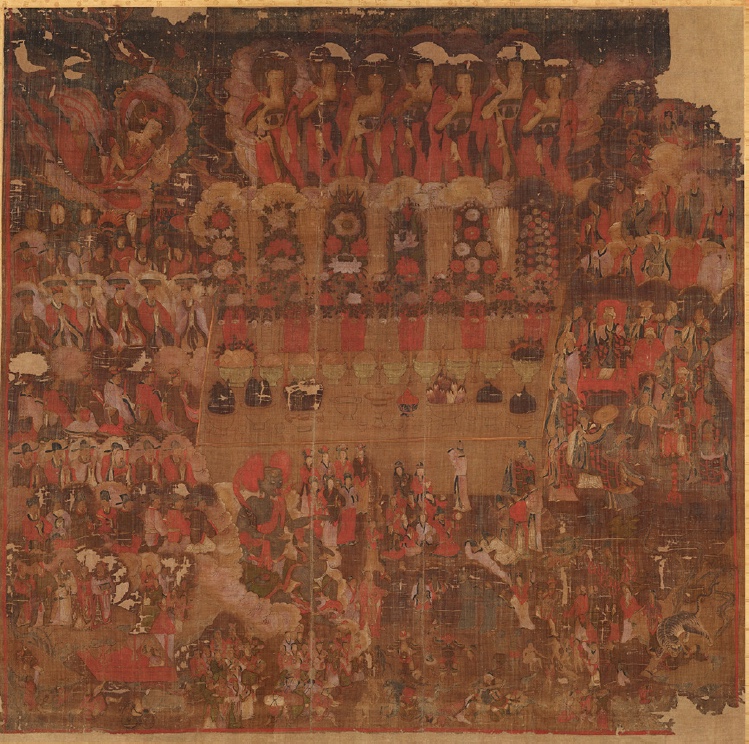
The Sweet-Dew painting (Kamnodo 甘露圖) emerged in sixteenth-century Korea to introduce an unprecedented pictorial representation of a group of Buddhas, whose functional significance lie in the “food bestowal” practice (shishik 施食) peculiar to Chosŏn Buddhist liturgy. Notwithstanding the obvious discrepancies in their compositional arrangements, several Buddhas constitute an assemblage, predominantly assuming visual ascendancy over the other Buddhist deities in the upper register of this new painting genre of the Chosŏn period (1392-1910).1 In the soteriological method of food bestowal, they are indeed the pivotal figures who collectively assume the role of a liturgical agent, exercising divine faculties indispensable for a successful execution of the rites which ultimately enable departed spirits to achieve rebirth in paradise. The presence of an assemblage of Buddhas in the Sweet-Dew painting thus perspicuously manifests its functional link to the modus operandi of salvation via the consumption of a mystically transformed salvific substance, the “sweet dew” (Kr. kamno 甘露; Skt. amṛta).
Considering the ritual application of the Sweet-Dew painting, Korean scholars have most notably attempted to construe its portrayals of the assemblage of Buddhas, with reference to canonical and extracanonical texts which expound the liturgical instructions on the rites involving the food bestowal. Initially, Hong Yunsik and Kim Sŭng-hŭi identified the assemblage as the Seven Buddhas (ch’iryŏrae 七如來 or Seven Tathāgatas), whose invocations are prescribed in the Yuqie jiyao jiu Anan tuoluoni yankou guiyi jing 瑜伽集要救阿難陀羅尼焰口軌儀經 (The Essentials of Yoga Teachings on the Dhāraṇī Flaming-Mouth Rite for Saving Ānanda) (T. 1318), one of the esoteric scriptures set forth the observance of the food bestowal to hungry ghosts (Kr. agwi餓鬼; Skt. preta), and the ritual manual for the performance of the kubyŏng shishik 救病施食 (Healing through the Bestowal of Food) included in the Food-Bestowal chapter (shishik p’yŏn 施食編) of Sŏngmun ŭibŏm 釋門儀範 (Manuals for Buddhist Rituals), a compendium of Korean Buddhist liturgies compiled by An Chinho in 1935.2 However, underlining the incompatibility of their appellations between the two texts, Pak Ŭnkyŏng further considered a corpus of food-bestowal-related texts that potentially have served as the grounds for the genre’s espousal of the Seven Buddhas and additionally the Five Buddhas (oyŏrae 五如來 or Five Tathāgatas), a variant formation also found in the Sweet-Dew painting, albeit only on rare occasions.3 Pak conclusively explicated that the Seven Buddhas appertain to those specified in the sixteenth- and seventeenth-century manuals of the Water-Land (suryuk ŭimun 水陸儀文), advocating the argument previously proposed by Yun Ŭhŭi.4 In the most recent study on this issue, Pak Jŏngwŏn also adopted a similar standpoint.5 This explanation consequently supported on its merits the general understanding in art-historical scholarship that the iconographies and the ritual function of the Sweet-Dew painting are primarily related to the Water-Land Ritual (Suryukchae 水陸齋).6 Meanwhile, however, Chŏng Myŏnghŭi advanced a divergent outlook on the nature of the texts formerly recognized as the Water-Land manuals.7 Taking a more inclusive approach, Chŏng regarded the textual sources for the Five and the Seven Buddhas to have embodied the belief in the deliverance of departed spirits, and she contended that the amalgamation of various Buddhist deities in the upper register of the Sweet-Dew painting attests the genre’s association to different Buddhist liturgies which entail the food bestowal.
In this article I take a particular stance that the Seven Buddhas portrayed in the Sweet-Dew painting are distinctively linked to their liturgical functions stipulated in the Chosŏn redactions of the Food-Bestowal manuals (shishik ŭimun 施食儀文), whose circulations are contemporaneous with the emergence of the genre in the sixteenth century. In undertaking the examination of the textual premise of the Seven Buddhas I seek to understand the liturgical inclusivity of the Sweet-Dew painting that occurred by virtue of its creation as the altarpiece for the low altar (hadan 下壇 or yŏngdan 靈壇, “spirit altar”) within the standardized ritual configuration of Chosŏn Buddhism.
The article is divided into three sections. In the first section I analyze the pictorial configurations of the Buddhas manifested in the extant specimens of the Sweet-Dew painting from the Chosŏn period.8 This endeavor identifies individual representations of the Five and the Seven Buddhas, especially the latter in different measures of dispositions. Precisely establishing the grounds for further investigation of the Seven Buddhas, the second section elucidates their common function as divine agents in the execution of the rites involving the bestowal of food to departed spirits. It chiefly determines the textual basis on which the Sweet-Dew painting has espoused the Seven Buddhas, by examining the specifications of the mantra invocations prescribed in different Buddhist texts related to the praxis of food bestowal. In further elaborating on the issue of textual association, the section three highlights the potential presence of the Sweet-Dew King (Kamnowang 甘露王) among the Seven Buddhas through particularizing his attributes evinced in the Sweet-Dew painting.
Ⅱ. The Assemblage of Buddhas in the Sweet-Dew Painting
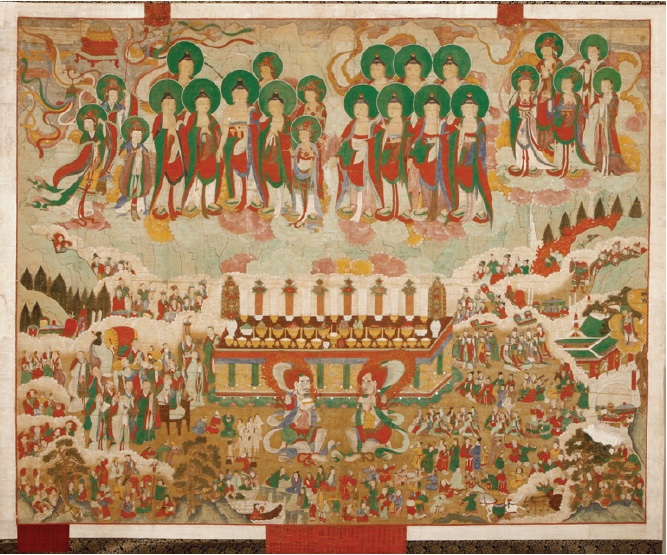
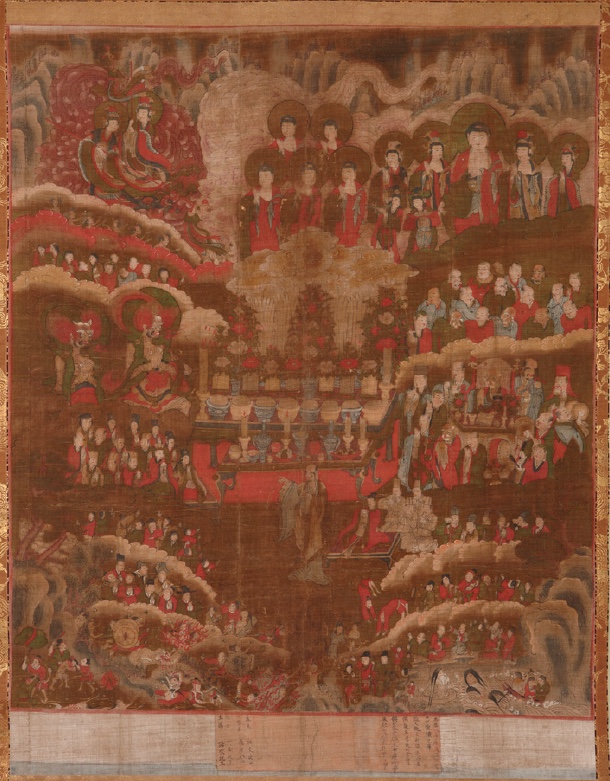
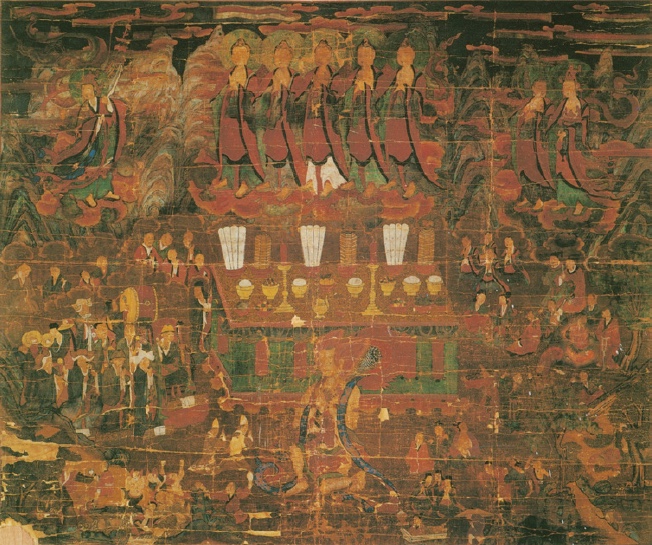
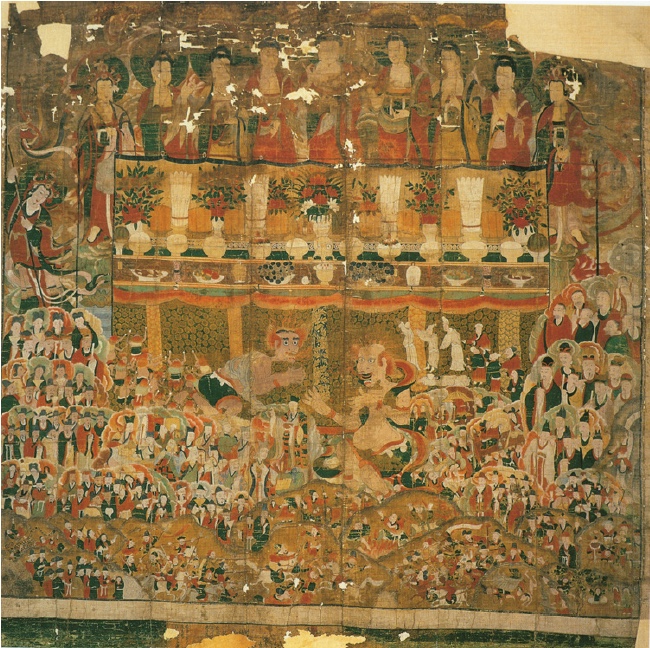
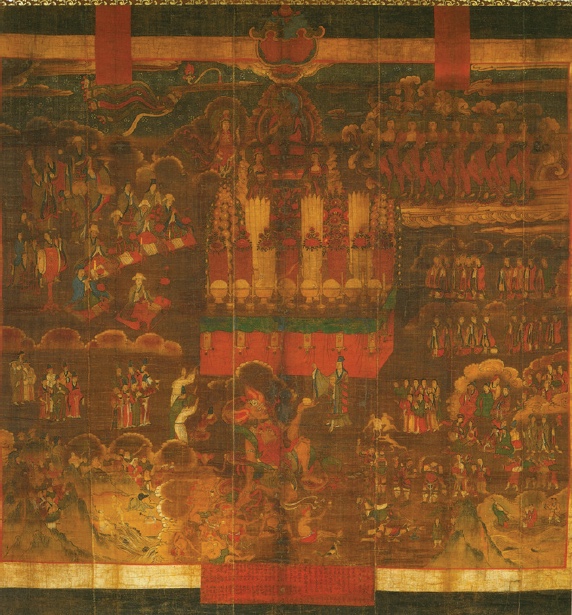
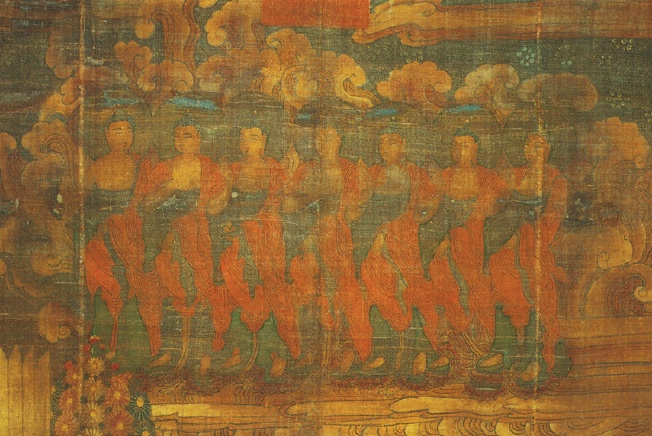
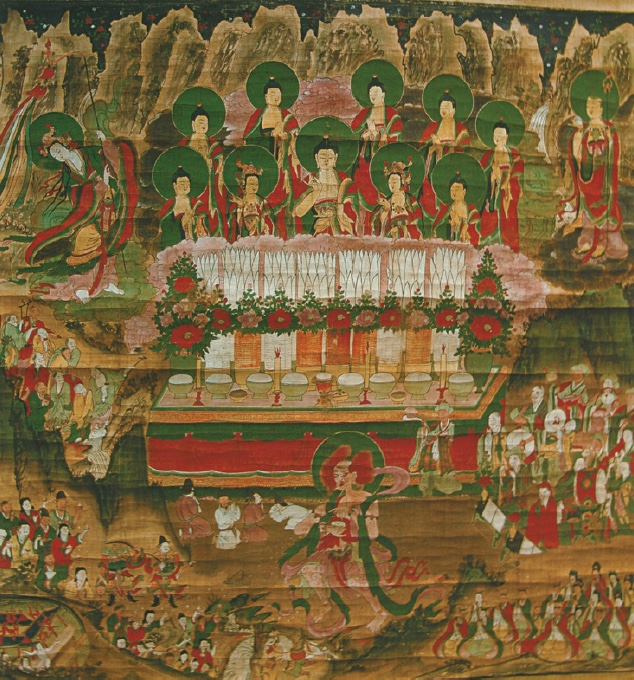
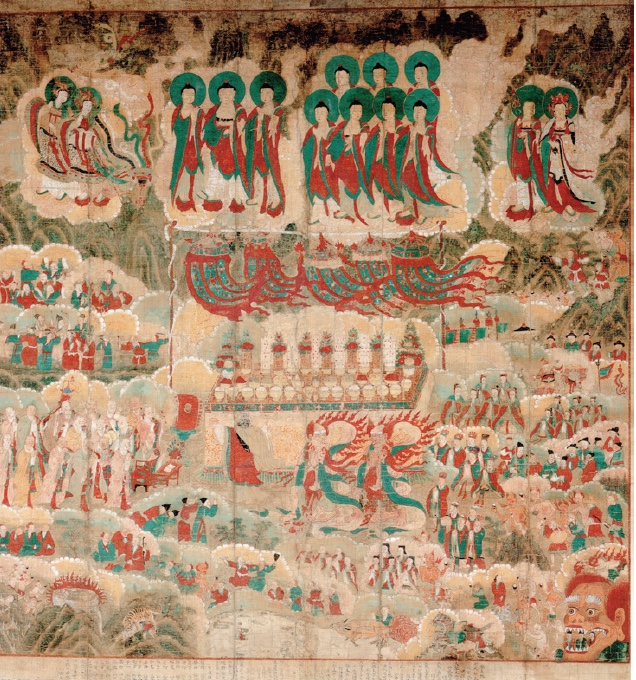
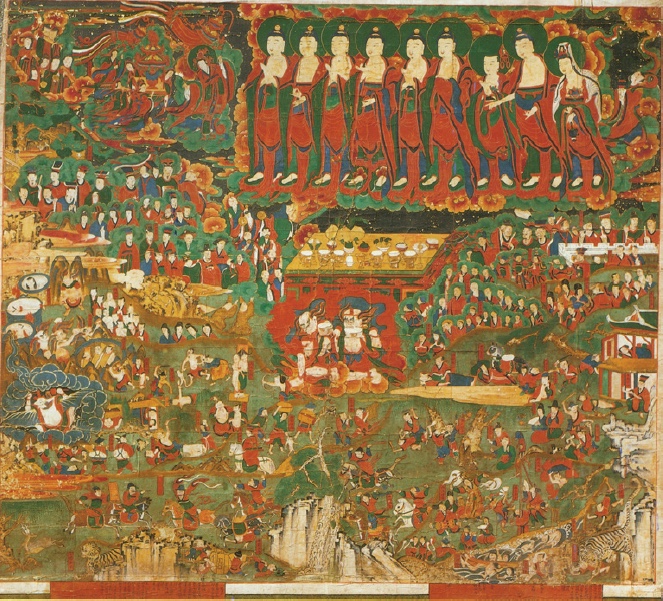
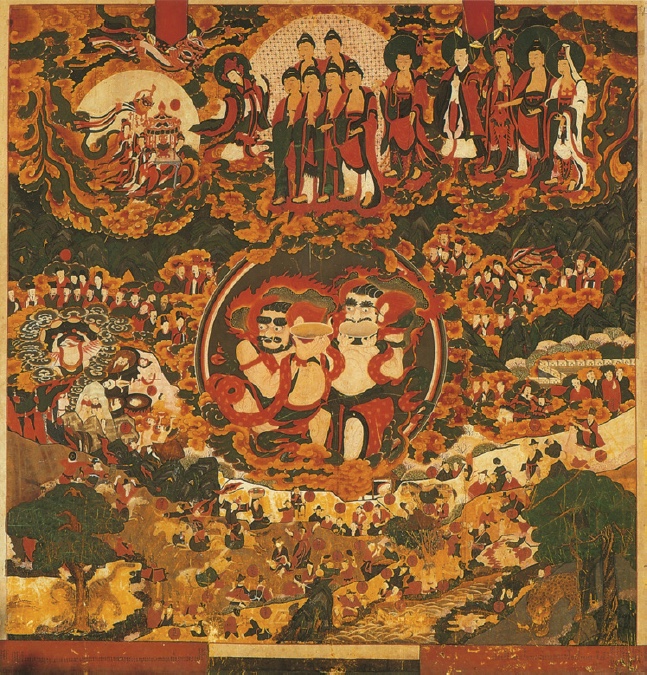
The Sweet-Dew painting conveys either of two different configurations of Buddhas in the upper portion of the picture plane (Table 1). One specimen that atypically exhibits both instances is the Sweet-Dew painting (Ssanggyesa Kamnodo 雙溪寺甘露圖, 1728) housed in the Ssanggyesa Museum (Fig. 1).9 Set against a mountainous backdrop, independent groups of the Five and the Seven Buddhas are juxtaposed among other Buddhist deities amid floating clouds. Of these two assemblages, the one comprising the Five Buddhas is first seen in the Sweet-Dew painting (Kamnodo 甘露圖) dated to 1580 (Fig. 2). It depicts a single group of the Five Buddhas immediately above the elaborate altar offerings. This particular form, however, occurred only on limited occasions thereafter. Merely two other specimens show similar representations from the entire extant corpus of seventy-four Sweet-Dew paintings assigned to the Chosŏn period:10 one housed in the Wŏlchŏngsa 月精寺 Museum (Yŏngwŏnsa Kamnodo 領願寺甘露圖, 1759) and another in a private collection (Kamnodo甘露圖, 18th cent.) (Fig. 3).11
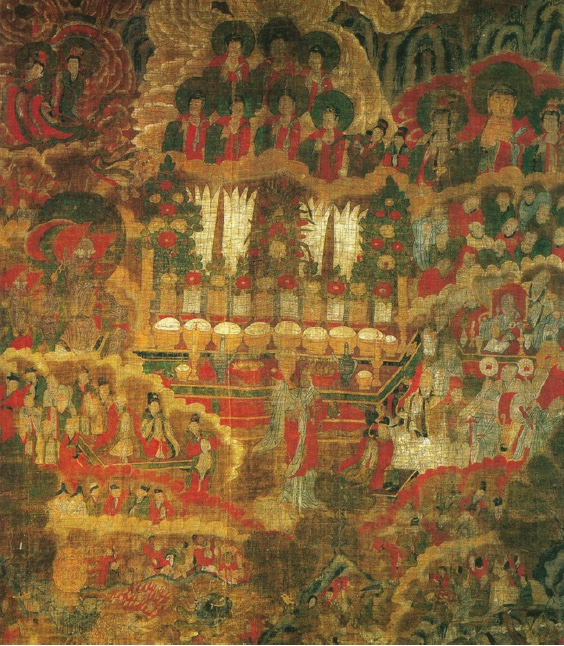
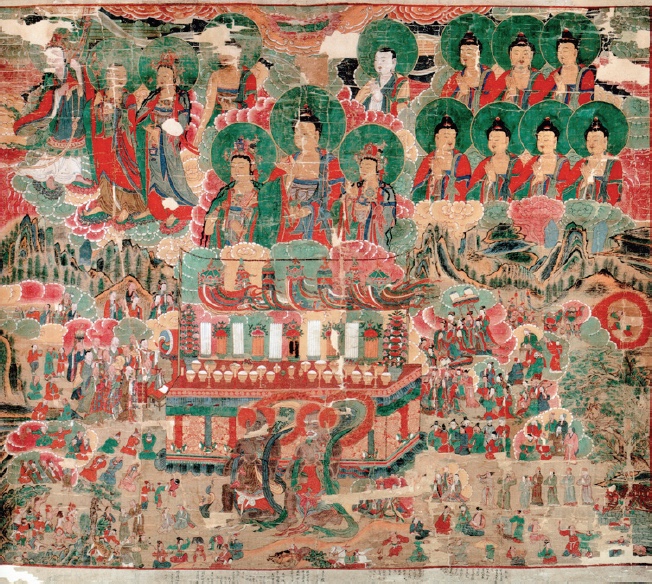
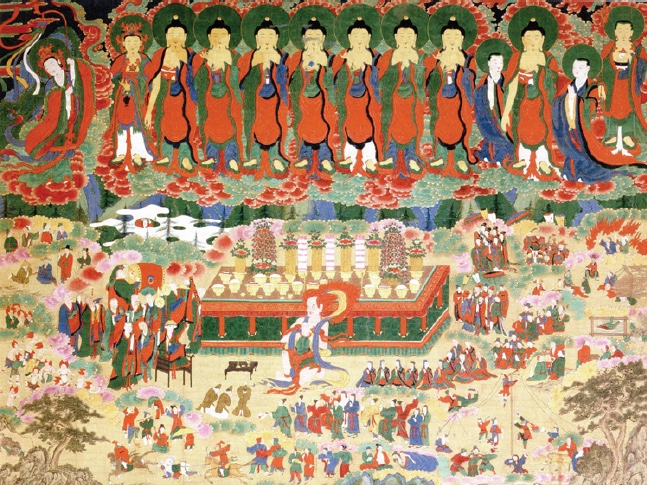
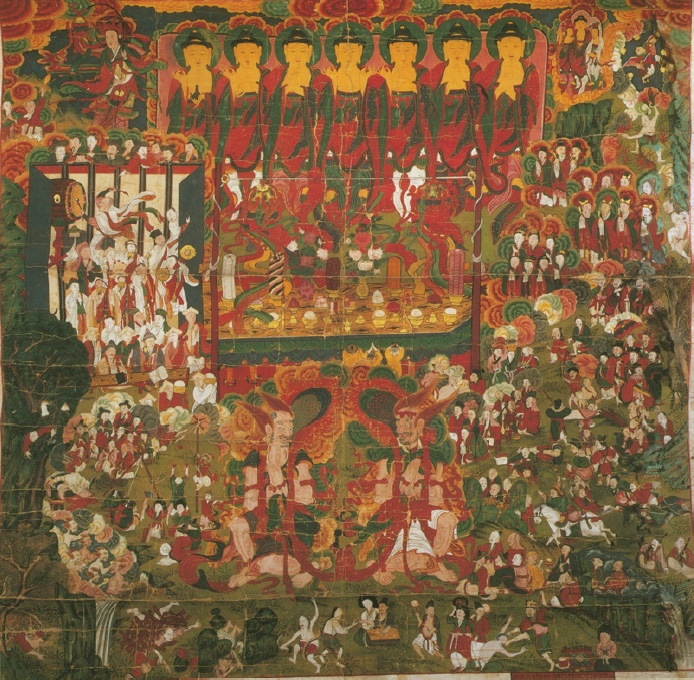
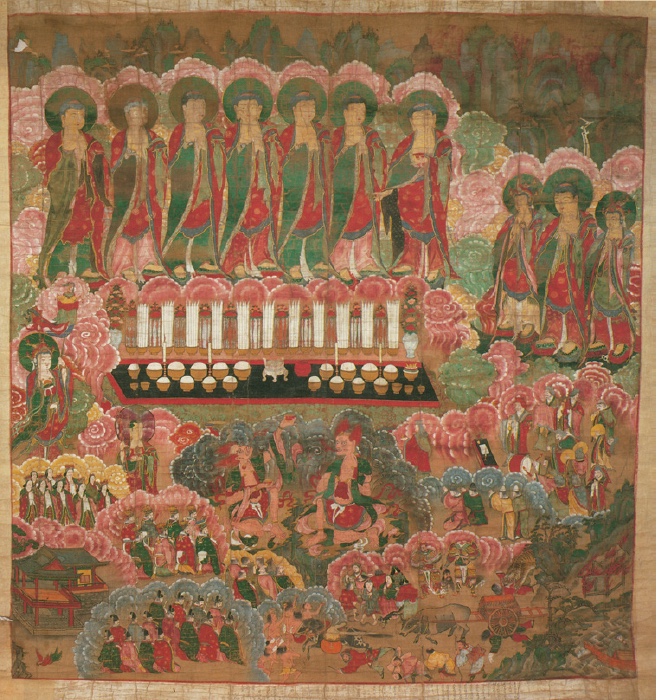
Apart from these three cases, all specimens of the Sweet-Dew painting deploy the Seven Buddhas in two different modes of formation. First, on most occasions the Seven Buddhas are assembled unequivocally into a single group featuring their central presence. For example, the early works include the Kōmyō-ji Sweet-Dew painting (Kōmyō-ji Kamnodo 光明寺 甘露圖, 16th cent.) in which the Seven Buddhas are depicted flanked by the Amitābha triad and the Bodhisattva Guide of Souls (Illowang posal 引路王菩薩) (Fig. 4). Moreover, in the case of the Posŏksa Sweet-Dew painting (Posŏksa Kamnodo 寶石寺 甘露圖, 1649), the Seven Buddhas dominate the upper portion of the picture plane attended by two bodhisattvas, and on one side is the Bodhisattva Guide of Souls (Fig. 5). Accordingly, similar visual setups of a single composition of the Seven Buddhas prevailed steadfastly throughout the Chosŏn period, with only rare exceptions. Although limited to a few cases, the sixteenth- and seventeenth-century works, in particular, also adopted variant dispositions. Among the eleven specimens dating from these periods, three arrange the Seven Buddhas in the manners that they visually subordinate to the Amitābha triad. The Sweet-Dew paintings in the collections of Yakusen-ji (Yakusen-ji Kamnodo 藥仙寺 甘露圖, 1589) and Ch’ŏngnyongsa (Ch’ŏngnyongsa Kamnodo 靑龍寺 甘露圖, 1692) portray the Seven Buddhas on the far right of the centrally stationed Amitābha triad (Figs. 6 and 7), and another in Saikyō-ji (Saikyō-ji Kamnodo 西敎寺 甘露圖, 1590) positions the Seven Buddhas at the center encircling the triad (Fig. 8).12 Despite such arrangements, however, in the entirety of the genre—the Amitābha triad does not constitute its primary iconography—often being absent as previously seen in the Posŏksa example (Fig. 5). Additionally, the Sweet-Dew painting in the Uhak Cultural Foundation (Kamnodo 甘露圖, 1681) arranges the Seven Buddhas in the position comparable to the aforementioned Ssanggyesa painting (Fig. 9). It juxtaposes the Seven Buddhas exceptionally with the Three Buddhas, placing each on either side of the central axis. Therefore, excluding only a few cases, a single composition of the Seven Buddhas engages the central position among other deities in the Sweet-Dew painting (Table 1).13
Second, the assemblages of the Seven Buddhas are configured in less conspicuous manners while likewise presiding over the upper register. Altogether nine specimens demonstrate such variant formations through rendering a group of six figures of Buddhas and the Buddha Amitābha, the last constituent of the Seven Buddhas, discretely accompanied by two attending bodhisattvas Avalokiteśvara and Mahāsthāmaprāpta (or Kṣitigarbha) (Table 1). Among them, three are relatively straightforward to identify. For example, the Sweet-Dew painting (Sudosa Kamnodo 修道寺 甘露圖, 1786) in the T’ongdosa Museum horizontally aligns a group of six Buddhas consecutively with the Amitābha triad (Fig. 10).15 Meanwhile, the remaining six paintings station the triad independently separated from the group of six Buddhas. For example, the Sweet-Dew painting from the Paek’ŭng Hermitage of Ŭnhaesa (Ŭnhaesa Paek’ŭngam Kamnodo 銀海寺 百興庵 甘露圖, 1792) assembles six Buddhas at the center above a pair of hungry ghosts, while positioning the Amitābha triad on the far right divorced from the main assemblage (Fig. 11).16 Accordingly, when the Sweet-Dew painting presents an assemblage consisted only of six figures of Buddhas, Amitābha joins the group, either on its contiguous side or detached from it, to form a complete representation of the Seven Buddhas.
Ⅲ. The Mantras of Invoking the Names of Buddhas Prescribed in the Buddhist Texts on Food-Bestowal Practices
The Buddhist texts associated with the ritual praxis of food bestowal offer instructions for invoking an assemblage of Buddhas, for the immediacy of their divine capacity in effectuating the salvific power of the rites. They include several canonical scriptures from which Rolf W. Giebel categorizes as a “group of texts describing the rites for the dead” (T. 1313-1321) and a body of redacted editions of the Water-Land and the Food-Bestowal manuals circulated in the Chosŏn period.17 Particularly, the latter texts of the sixteenth century merit attention for their prevalence closely linked to the contemporaneous emergence of the Sweet-Dew painting; the period, in fact, marked a historical juncture that saw a proliferation of the Water-Land manuals and, more importantly, the inception of independent publications of the Food-Bestowal manuals.18
However, despite their joint interest in providing the method of food bestowal, the aforementioned collections of texts put forward variable prescriptions for invoking the names of the Buddhas whereby the rite exercises its efficacy. On what ground do we then determine the textual foundation of the assemblage of Buddhas portrayed in the Sweet-Dew painting? Pursuant to the liturgical aim of the food bestowal, the most preeminent features contributing to the pictorial representation of the assemblage are arguably the presence of the Sweet-Dew King (Kr. Kamnowang yŏrae 甘露王如來; Skr. Amṛta Rājāya Tathāgata) and his divine task directly connected to the salvific capacity of consumption, as also inferred from the title attributed to the genre. Based on this premise, the following pages will identify the Sweet-Dew King’s liturgical connection to the food bestowal and the precise chronological juncture of its advent, in order to shed light on the textual basis that has shaped the Seven Buddhas in the Sweet-Dew painting.
As early as the eighth century, the Chinese translations of esoteric scriptures have advanced the mantra (jineon 眞言) recitations involving an elaboration of the names of Buddhas for the execution of the rites of food bestowal.19 One of the earliest texts, the Foshuo jiuba yankou egui tuoluoni jing 佛說救拔焰口餓鬼陀羅尼經 (Buddha’s Discourse on the Dhāraṇī Scripture for Saving the FlamingMouth Hungry Ghost, hereafter Flaming-Mouth Sūtra) (T. 1313; K. 1302), details the Buddha’s instruction to Ānanda the method of food bestowal that requires invoking the Four Buddhas (sayŏrae 四如來or Four Tathāgatas) in the following order:
1. Duobao rulai多寶如來 (Many Treasures)
2. Miaoseshen rulai 妙色身如來 (Wonderful-Form Body)
3. Guangboshen rulai 廣博身如來 (Expansive Body)
4. Libuwei rulai 離怖畏如來 (Separated from Fear)20
In undertaking the procedure, the text also explicated the power (Kr. kaji 加持; Skt. adhiṣṭhāna) generated by each name of the Buddha. Most notable among the Four Buddhas is the Expansive Body (Kr. Kwangbakshin 廣博身), whose divine power assumes a direct connection to consumption enabling the throats of departed spirits to open and fulfill their hunger.21
In three other esoteric scriptures possibly of later date, the aforementioned formula underwent a process of expansion to specify the mantras of either the Five or the Seven Buddhas (Table 2).22 For example, as enumerated below, the Shi zhu egui yinshi ji shui fa 施諸餓鬼飲食及水法 (Bestowing Food and Drink to All Hungry Ghosts and the Water Method, hereafter Bestowing Food and Water Method) (T. 1315) prescribes the names of the Five Buddhas:
1. Baosheng rulai 寶勝如來 (Precious Victory)
2. Miaoseshen rulai 妙色身如來 (Wonderful-Form Body)
3. Ganluwang rulai 甘露王如來 (Sweet-Dew King)
4. Guangboshen rulai 廣博身如來 (Expansive Body)
5. Libuwei rulai 離怖畏如來 (Separated from Fear)23
From the previous sequence of mantras, the Bestowing Food and Water Method replaced the Many Treasures (Kr. Tabo yŏrae 多寶如來) with the Precious Victory (Kr. Posŭng yŏrae 寶勝如來) and newly included the Sweet-Dew King.25 The Precious Victory thereby acquired the equivalent capacity of the Many Treasures and the Sweet-Dew King the power to “[confer] the heart of the Dharmakāya, causing the attainment of definite bliss.”26 Meanwhile, the Expansive Body maintained his engagement in expanding the throats of departed spirits and thus allowing them to enjoy the “wonderful taste.”27
Similarly, the Chosŏn manuals of the Water-Land espoused the mantras of the Five Buddhas and their respective involvements in the food bestowal (Table 2). Among the three most widespread editions in the sixteenth century, the Suryuk much’a p’yŏngdŭng chaeŭi ch’waryo 水陸無遮平等齋儀撮要 (The Abbreviated Ritual for the Water and Land Unobstructed, Equal Feast), for example, includes a chapter on the invocation of Buddhas (sŏnyang sŏngho p’yŏn 宣揚聖號篇), which presents the mantras of the Five Buddhas accompanied with the illustrations of corresponding mudrās.28 Apart from the Many Treasures, who replaces the Precious Victory, the names of the Buddhas and their functional link to the food bestowal correlate to the Bestowing Food and Water Method, albeit in different order. In fact, the given configuration has prevailed as early as the fourteenth century in the Ch’ŏnji myŏngyang suryuk chaeūi ch’anyo 天地冥陽水陸齋儀纂要 (Essential Rules for the Ceremony of the Heaven and Earth, Day and Night, Water and Land Feast) compiled by the Koryŏ monk Chugam Yugong 竹菴猷公 (n.d.).29 Moreover, another popular Chosŏn edition, the Pŏpkye sŏngbŏm suryuk sŭnghoe sujae ŭigwe 法界聖凡水陸勝會修齋儀軌 (The Rules for the Excellent Assembly for the Observation of the Feast for the Dharmadhātu’s Holy and World in Water and on Land), likewise specify the Five Buddhas assuming similar powers.30
Above all, the texts which expound the Seven Buddhas merit special attention as regards the iconographic arrangements of the Sweet-Dew painting examined in the previous section. They include two canonical texts and several Chosŏn redactions of the Food-Bestowal manual emerged around the sixteenth century (Table 2). First, the Yuqie jiyao jiu Anan tuoluoni yankou guiyi jing 瑜伽集要救阿難陀羅尼焰口軌儀經 (The Scripture from the Essentials of Yoga Teachings on the Dhāraṇī Flaming-Mouth Rite for Saving Ānanda) (T. 1318) and the Yuqie jiyao yankou shishi yi 瑜伽集要焰口施食儀 (Essentials of Yoga Teachings for Bestowing Food to Flaming Mouths) (T. 1320) uniformly set forth the names of the Seven Buddhas as below:
1. Baosheng rulai 寶勝如來 (Precious Victory)
2. Libuwei rulai 離怖畏如來 (Separated from Fear)
3. Guangboshen rulai 廣博身如來 (Expansive Body)
4. Miaoseshen rulai 妙色身如來 (Wonderful-Form Body)
5. Duobao rulai 多寶如來 (Many Treasures)
6 .Amituo rulai 阿彌陀如來 (Infinite Light)
7. Shijian guangda weide zizai guangming rulai 世間廣大威德自在光明如來 (Physical World, Wide and Large, Authority and Virtue, Unrestricted, and Bright)31
The list has been configured fundamentally based on the arrangement of the Five Buddhas, while additionally including the Many Treasures, Infinite Light (Kr. Amit’a; Skt. Amitābha) and the Physical World, Wide and Large, Authority and Virtue, Unrestricted, and Bright (Kr. Segan kwangdae widŏk chajae kwangmyŏng yŏrae 世間廣大威德自在光明如來) and omitting the Sweet-Dew King. In both texts, the capacity of opening the needle-like throats of departed spirits (or hungry ghosts) remained connected to the Expansive Body, and its description further specified the salvific substance to be consumed as the “sweet dew.”32
Second, the Chosŏn redactions of the Food-bestowal manuals likewise expound the Seven Buddhas (Table 2). However, they are clearly distinguished for their inclusion of the Sweet-Dew King after the earlier arrangement in the Bestowing Food and Water Method. Notwithstanding, these manuals associate the Sweet-Dew King with the capacity that had been previously given to the Expansive Body, reversing the liturgical tasks between the two deities. Such emendation initially occurred in the Samdan shishingmun 三壇施食文 (Text of the Three-Altar Food Bestowal) compiled in 1496 (Table 3).33 Within the offertory services of the three altars (comprising high, middle and low altars), the food bestowal of the low altar particularly involved the procedure of invoking the Seven Buddhas in facilitating the salvation for departed spirits (manghon 亡魂 or hawi 下位, “the low-status beings”). Starting with the Many Treasures, the text enumerates the names of the Buddhas to be invoked for their divine powers, to transfigure the departed spirits into the condition suitable for consuming the sweet dew and ultimately to bestow upon them a rebirth in paradise.35 In the process, notably, the Sweet-Dew King confers his blessings to “open the needle-like throats of departed spirits and taste the sweet dew,” while the Expansive Body “helps all departed spirits to free themselves from the body of the six realms of existence in order to obtain the dharma-body” (Table 3). The subsequent editions of the Food-Bestowal manual, which began to circulate in the sixteenth century, also detail the instruction equivalent to the Samdan shishingmun (Table 2).36 Accordingly, the recitations of the names of the Seven Buddhas became standard for the food bestowal of the low altar (hadan shishik 下壇施食), distinctively implementing the link between the Sweet-Dew King and the liturgical task of opening of the needle-like throats of departed spirits.
Ⅳ. The Sweet-Dew King among the Seven Buddhas
Correlating with the Sweet-Dew King’s immediate association to the salvific scheme of the food bestowal, his presence among the Seven Buddhas is discernible in several extant specimens of the Sweet-Dew painting. In fact, the four different titles traditionally ascribed to the Sweet-Dew painting also include “Kamnowang t’aeng” 甘露王幀 (a hanging scroll of the Sweet-Dew King),37 and thus, suitably, the title “Sweet-Dew King” (Kamnowangdo 甘露王圖) was commonly used in modern scholarship especially in the 1980s and 90s when the art-historical studies of this Buddhist painting genre began to accumulate in Korea.38 Notwithstanding, the iconographic identification of the Sweet-Dew King has not been carefully considered, as the title was treated as one of the appellations of Amitābha and also due to the preference of alternative titles in subsequent or related studies. Particularly with regard to the former, the primary iconographic focus had been the “descent” imagery of the Amitābha triad, which was argued to dominate the illustration featuring the notion of salvation related to Pure Land faith.39 Its applicability to the extent works, however, is meager; even the four specimens whose written record (hwagi 畵記) bear the title “Kamnowang t’aeng” show iconographic discrepancies not quite corresponding to this explanation.40 Moreover, as previously examined in the first section of this paper, the Amitābha triad does not consistently appear in the genre’s extant specimens. Equating the Sweet-Dew King with Amitābha in the pictorial program of the Sweet-Dew painting is seemingly questionable, since the Food-Bestowal manuals also specify the mantras of individual Buddhas and distinguish their capacities. Rather, the potential presence of the Sweet-Dew King can be determined by particularizing the iconography in association to the textual description of his liturgical role.
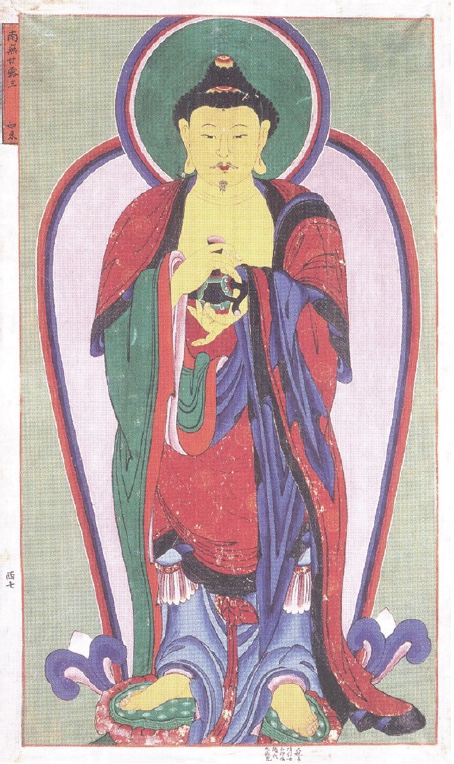
The Seven Buddhas represented in the Sweet-Dew painting generally lack individual characteristics. Some distinctions are observable in their hand gestures, but they still have limited degree of consistency. Moreover, although there are nine alternative formations of the Seven Buddhas in which Amitabha is depicted independently with two attending bodhisattvas, the identities of the remaining Buddhas are not readily apparent.41 On some occasions, however, one particular Buddha can arguably be recognized as the Sweet-Dew King. The most representative example is shown in the Sweet-Dew painting housed in the Peabody Essex Museum (Kamnodo甘露圖, 1744) (Fig. 12).42 In the upper section of the painting, only the Buddha positioned at the very center of the Seven Buddhas appears holding a small bottle with both hands. Notably, this portrayal precisely parallels the representation of the “Sweet-Dew King” in the scroll created as a part of the set of ritual banners of the Seven Buddhas (Ch’iryŏraedo 七如來圖) and whose name is verified by the accompanying inscription (Namu Kamnowang 南無甘露王) (Fig. 13). The two Buddhas display a striking iconographic affinity even in the manner they are holding the bottle. A further example reinforces this observation. The Sweet-Dew painting in the Guimet Museum collection (Manwŏlsan Suguksa Kamnodo 滿月山 守國寺 甘露圖, 1832) represents one of the Seven Buddhas holding a kundika-shaped bottle that closely resembles the one held by the Sweet-Dew King in the scroll (Fig. 14).
Based on these convincing identifications, we may also associate the Sweet-Dew King with the Buddha holding an alms bowl. Attributed with either a small bottle or a bowl, the Sweet-Dew King seems to have effectively displayed his liturgical role among the Seven Buddhas, which involves enabling departed spirits to consume (or taste) the sweet dew by opening their needle-like throats, after the specifications of the Food-Bestowal manuals discussed in the previous section. Such liturgical significance of the Sweet-Dew King is especially articulated in the Haeinsa Sweet-Dew painting (Haeinsa Kamnodo 海印寺甘露圖, 1723) (Fig. 15). W hile the other Buddhas are uniformly depicted with their palms joined together, the Buddha standing at the right end of the assemblage is holding a small bowl in one hand and the opposite hand lowered in the direction of one of the two hungry ghosts below the ritual altar. Seemingly in response to this action, the hungry ghost tilts its head backward to look up and raises one of its alms bowls towards the Buddha. The visual connection between the Buddha and the hungry ghost is exceptionally explicit. In fact, this piece is one of the four extant specimens that bears the title “Kamnowang t’aeng,” reasonably in reference to the Buddha portrayed with a small bowl.43 Although such degree of visual specification is scarcely seen in the Sweet-Dew paintings, the genre seems to have distinguished the Sweet-Dew King already at the outset of its creation. Two of the six extant specimens from the sixteenth century in the collections of Yakusen-ji (Yakusen-ji Kamnodo 藥仙寺甘露圖, 1589) and the National Museum of Korea (Ryūgan-ji Kamnodo 龍岸寺 甘露圖, 16th cent.) portray one of the Seven Buddhas holding a small bowl filled with a solid substance, presumably indicative of an alternative pictorial mode of the Sweet-Dew King’s engagement in the food bestowal (Figs. 6, 6-1, and 16).
Ⅴ. Conclusion
The prevalence of the Sweet-Dew Buddhist painting genre testifies a significant liturgical focus on the salvific praxis of the food bestowal in the Chosŏn period. Within the offertory services consulted on the three-altar scheme, the Sweet-Dew painting has become an indispensable part of diverse rituals, both daily and occasional, involving the deliverance of sentient beings belonging to the “low-status” category of existence. For its generic characteristics as an altarpiece for the low altar, the genre’s multifarious iconography displays irrefutable associations to a corpus of Buddhist literatures that mutually expound on the food-bestowal practice.44 Nevertheless, the most fundamental texts immediately linked to its opportune advancement are arguably the Food-Bestowal manuals that made headway around the sixteenth century, initiating with the Samdan sisikmun and subsequently redacted and independently compiled texts for the performance of bestowing food to departed spirits.
In that framework, as examined in the previous three sections, the representation of the Seven Buddhas lucidly demonstrates close image-text relations between the Sweet-Dew painting and the Food-Bestowal manuals. While allowing some variables in the compositional arrangement, the Sweet-Dew painting has portrayed the Seven Buddhas for their essential role as divine agents in the method of food bestowal, adhering above all to the prescriptions of the Food-Bestowal manuals circulated at the approximate historical juncture that saw its creation for the low ritual altar. Their comparability is distinctively discernible in the identification of the Sweet-Dew King. In manifesting the preeminent power of the Sweet-Dew King, some specimens have shown his presence more straightforwardly by attributing a small bottle or a bowl, directly referencing the liturgical task related to the consumption of the sweet dew. Despite the need for further investigation of the Five Buddhas found in a few early specimens, the prevailing pictorial representation of the Seven Buddhas precisely evinces the textual basis for its assemblage and their liturgical capacity conveyed in the Sweet-Dew painting.
<Table 1> The Assemblage of Buddhas in the Sweet-Dew Painting of the Chosŏn Period (1392-1910)
| Mode of Configuration | Five Buddhas | Seven Buddhas | ||
|---|---|---|---|---|
| Single composition | At the center | 3 | At the Center | 57 |
| On the side or encircled around the Amitābha triad | 3 | |||
| At the central plane juxtaposed with another group of Buddhas | 2 [14] | |||
| Variant composition | - | - | A group of six Buddhas aligned with the Amitābha triad | 3 |
| The Amitābha Triad disjoined from the group of six Buddhas | 6 | |||
| Subtotal | 3 | 71 | ||
| Total | 74 | |||
<Table 2> The Invocation of Buddhas Prescribed by the Buddhist Texts Expounding the Method of Food Bestowal24
| Five Buddhas | Seven Buddhas | ||
|---|---|---|---|
| Esoteric Buddhist Canon | Shi zhu egui yinshi ji shui fa 施諸餓鬼飲食及水法 (T. 1315) | Esoteric Buddhist Canon | Yuqie jiyao jiu Anan tuoluoni yankou guiyi jing 瑜伽集要救 阿難陀羅尼焰口軌儀經 (T. 1318) |
| Yuqie jiyao yankou shishi yi 瑜伽集要焰口施食儀 (T. 1320) | |||
| Joseon Redactions of the Water-Land manuals | Ch’ŏnji myŏngyang suryuk chaeŭi ch’anyo 天地冥陽水陸齋儀纂要 | Joseon Redactions of the Food-Bestowal manuals | Samdan shishingmun 三壇施食文 |
| Pŏpkye sŏngbŏm suryuk sŭnghoe sujae ŭigwe 法界聖凡水陸勝會修齋儀軌 | Chŭngsu sŏn’gyo shishik ŭimun 增修禪敎施食儀文 | ||
| Taech’al samyŏngil yŏnghon shishik ŭimun 大刹四明日迎魂施食儀文 | |||
| Suryuk much’a p’yŏngdŭng chaeŭi ch’waryo 水陸無遮平等齋儀撮要 | Unsudan 雲水壇 (Unsudan kasa 雲水壇謌詞) | ||
| Chebanmun 諸般文 | |||
<Table 3> The Seven Buddhas and Their Liturgical Tasks Stipulated in the Samdan shishingmun (Text on Three-Altar Offerings)34
| Seven Buddhas | Liturgical Tasks |
|---|---|
| Tabo yŏrae | Extinguishes the greedy, parsimonious nature of all departed spirits and fulfills them with Buddha’s teaching |
| 多寶如來 | |
| (Many Treasures) | 某靈駕法界亡魂 破除慳 貪法財具足 |
| Posŭng yŏrae | Helps all departed spirits to abandon inferior modes of existence and elevates their path for existence |
| 寶勝如來 | |
| (Precious Victory) | 某靈駕法界亡魂 各捨惡 道隨意超升 |
| Myosaekshin yŏrae | Transforms the filthy and uncanny appearance of all departed spirits into one that is pure and gentle |
| 妙色身如來 | |
| (Wonderful-Form Body) | 某靈駕法界亡魂 離醜 陋形相好圓滿 |
| Kwangbakshin yŏrae | Helps all departed spirits to free themselves from the body of the six realms of existence in order to obtain the dharma-body |
| 廣博身如來 | |
| (Expansive Body) | 某靈駕法界亡魂 捨六凡身悟淸淨虛空身 |
| Ip’ooe yŏrae | Helps all departed spirits to be free from fear and to obtain the joy of enlightenment |
| 離怖畏如來 | |
| (Separated from Fear) | 某靈駕法界亡魂 離諸怖畏得涅槃樂 |
| Kamnowang yŏrae | Opens the needle-like throats of all departed spirits to taste the sweet dew |
| 甘露王如來 | |
| (Sweet-Dew King) | 某靈駕法界亡魂 咽喉開通獲甘露味 |
| Amit’a yŏrae | Helps all departed spirits to be reborn in the realm of paradise |
| 阿彌陀如來 | |
| (Infinite Light) | 某靈駕法界亡魂 隨念超生極樂世界 |
Abbreviations
- HPC
- Han’guk pulgyo ŭirye charyo ch’ongsŏ 韓國佛敎儀禮資料叢書
- K
- Koryŏ taejanggyŏng 高麗大藏經
- T
- Taishō shinsū daizōkyō 大正新修大藏經