The Power of Images: A Double Fifth Painting at the Qing Court and Its Apotropaic Power
1 Ewha Womans University
Abstract
This paper studies an anonymous Double Fifth painting kept at the National Palace Museum in Taipei for its intended apotropaic power. Using historical records and stylistic analyses, the paper posits that the anonymous Double Fifth was made in the Qianlong reign. The paper then explores how the painting intends to be an efficacious image in an iconographical and stylistic sense. Compared to a similar Double Fifth painting signed by Giuseppe Castiglione, the anonymous version has more elements added such as Daoist talismans, Zhong Kui, and a hanging paper cut-out in the shape of a tiger, all of which were meant to fortify the painting’s apotropaic power. On the other hand, the addition of these elements makes the anonymous version less realistic compared to Castiglione’s version. This paper argues, however, that the anonymous version asserts its efficacy on stylistic and pictorial grounds without resorting to mimesis based on realistic representation. To argue this, the paper goes beyond decoding the iconographic meaning of the various elements added in the anonymous version to properly analyze the pictorial mechanism of how such elements are depicted and functioning in the painting. Through such analysis, this paper explores how Chinese seasonal paintings could be studied and interpreted not merely as a system of symbols, but also as a visual apparatus intended to maximize the painting’s efficacy by pictorial means. Ultimately, the paper aims to seek new conceptual and analytical methods of probing the power of images beyond the theory of realistic resemblance.
Ⅰ. Introduction
This paper studies an anonymous Double Fifth painting kept at the National Palace Museum in Taipei for its intended apotropaic power. Using historical records and stylistic analyses, the paper posits that the anonymous Double Fifth was made in the early Qianlong reign. Once misattributed to the Yuan dynasty, the painting has been reattributed to the Qing period based on, among other factors, its similarity to another Double Fifth painting signed by Giuseppe Castiglione. Dating the anonymous version more specifically to the early Qianlong reign serves to establish a close proximity in time and place of the anonymous version to Castiglione’s version, justifying looking at these two paintings side by side. Furthermore, by suggesting that the anonymous version was made later than the Castiglione version, this article builds an alternative hypothesis to the existing one that the anonymous version was made as a preparatory sketch for Castiglione’s work1.
After provisionally establishing the relation between the two Double Fifth paintings, the paper explores how the anonymous Double Fifth intends to be an efficacious image in an iconographical and stylistic sense. Based on their largely shared iconography, it can be inferred that both paintings were made for a protective function for the Double Fifth, a time considered dangerous in traditional cosmology due to the yin and yang energy competing2. However, the anonymous version has more elements added such as Daoist talismans, Zhong Kui, and a hanging paper cut-out in the shape of a tiger, which were clearly meant to fortify the painting’s apotropaic powers. On the other hand, the addition of these elements makes the anonymous version more incongruous and less realistic compared to Castiglione’s version, which is executed with the Milanese painter’s deft application of shadows and coherent scaling of objects. In the discipline of Art History, the most established and often-quoted theory for explaining the power of images is mimesis: the idea that a painting wields the same power as its referent to viewers by approximating the look of the referent3. If one were to understand the power of images from this perspective, then on stylistic grounds the Castiglione version would be considered more efficacious, while the anonymous version may be more iconographically comprehensive.
This paper argues, however, that the anonymous version also seeks efficacy on pictorial and stylistic grounds that may be understood differently from the power of mimesis and resemblance. To argue this, the paper goes beyond decoding the iconographic meanings of the various elements added in the anonymous version to properly analyze the pictorial mechanism of how such elements are depicted and functioning in the painting. Through such analysis, this paper explores how Chinese seasonal paintings could be studied and interpreted not merely as a system of symbols, but also as a visual apparatus intended to maximize the painting’s efficacy through pictorial means4. Ultimately, the paper aims to seek new conceptual and analytical methods of probing the power of images beyond mimesis and resemblance.
Ⅱ. Two Double Fifth Paintings at the Qing Court
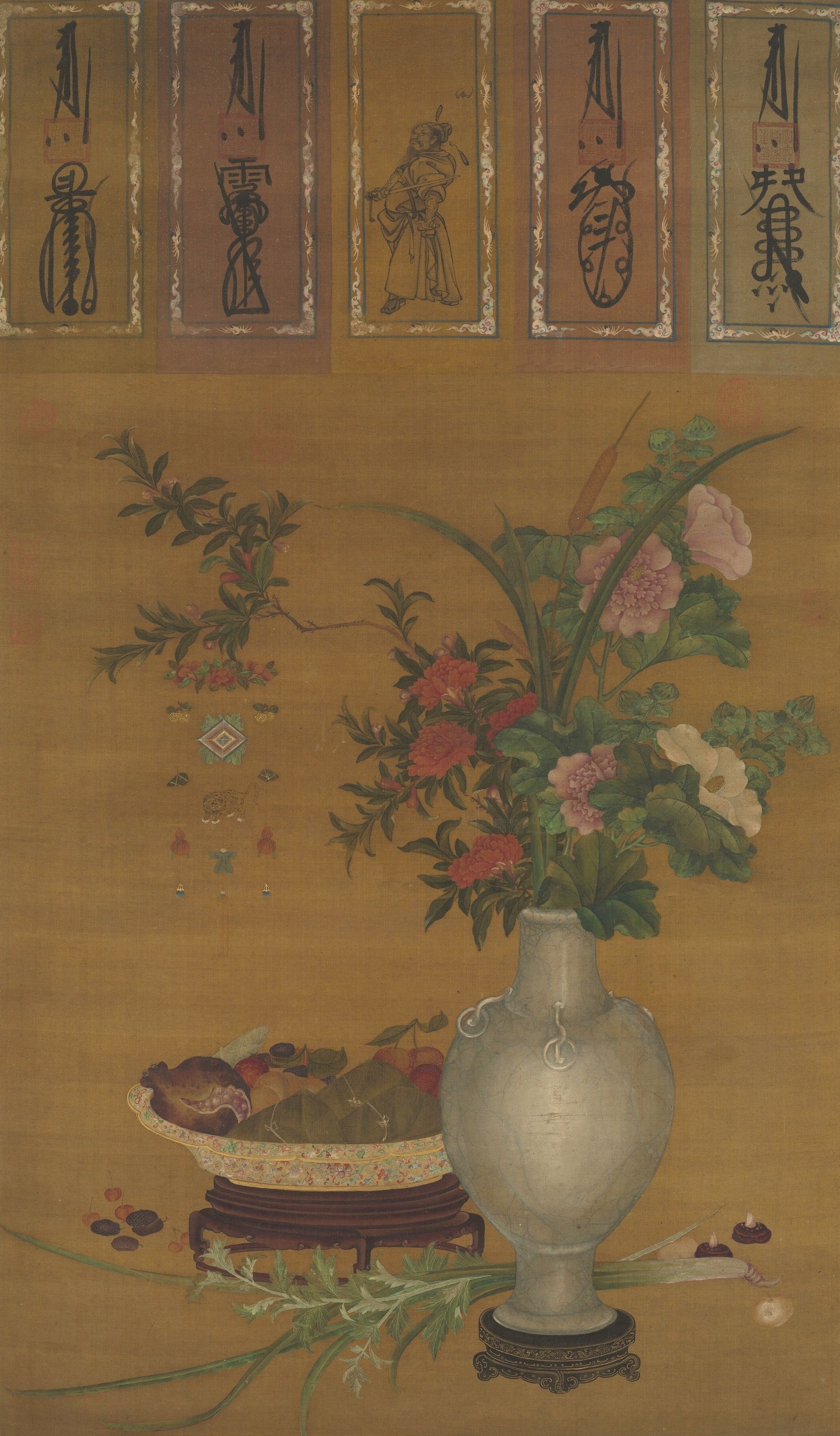
The anonymous Double Fifth in Taipei shows elements associated with the special day (Fig. 1). An arrangement of flowers in the vase indicates the early summer season when the Double Fifth takes place: hollyhocks, pomegranate flowers, peonies, and cattails. Next to the vase is a wide serving dish with lychees, cherries, mulberries, a ripe pomegranate, and glutinous rice cakes wrapped in bamboo leaves. Between the basin and the vase lie mugwort and calamus, which are fragrant plants hung on doors or roofs on the Double Fifth or worn by children to repel insects. Chinaberries (a medicial ingredient that treats heatstrokes), mulberries, cherries, and Chinese water chestnuts are scattered on the ground as well. The collection of flowers, fruits, and plants clearly identifies the painting as one made for the Double Fifth.
For thorough iconographic and ethnographic studies on the topic, see
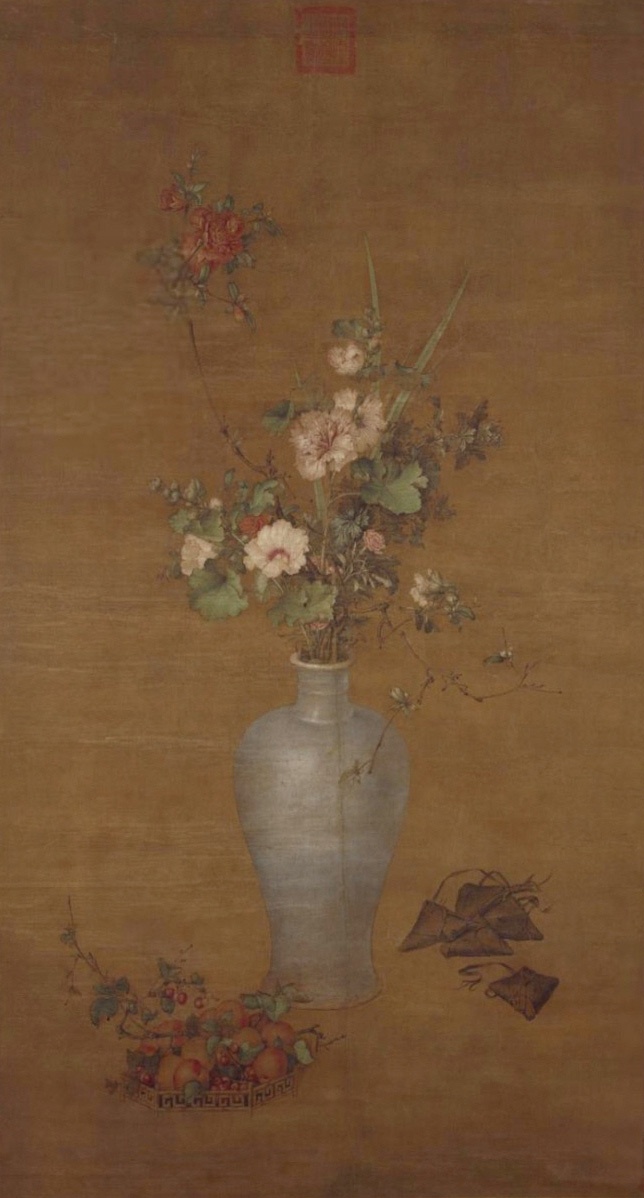
The painting has no artist seals or inscriptions on it, but there is another painting that closely resembles this one in style and content: the Double Fifth painted and signed by Giuseppe Castiglione (郎世寧, 1688~1766) at the Beijing Palace Museum (Fig. 2). There is a signature by Castiglione on the lower right corner: “Your servant Lang Shining respectfully painted” (臣郎世寧恭畫), and two Lang Shining seals, “Servant Shining” (臣世寧) and “Respectfully Painted” (恭畫). At the top center is a Qianlong (1735~1796) seal. This Double Fifth in Beijing also shows cattails, hollyhocks, pomegranate flowers, glutinous rice cakes, apricots, and cherries, largely overlapping with the anonymous Double Fifth in Taipei.
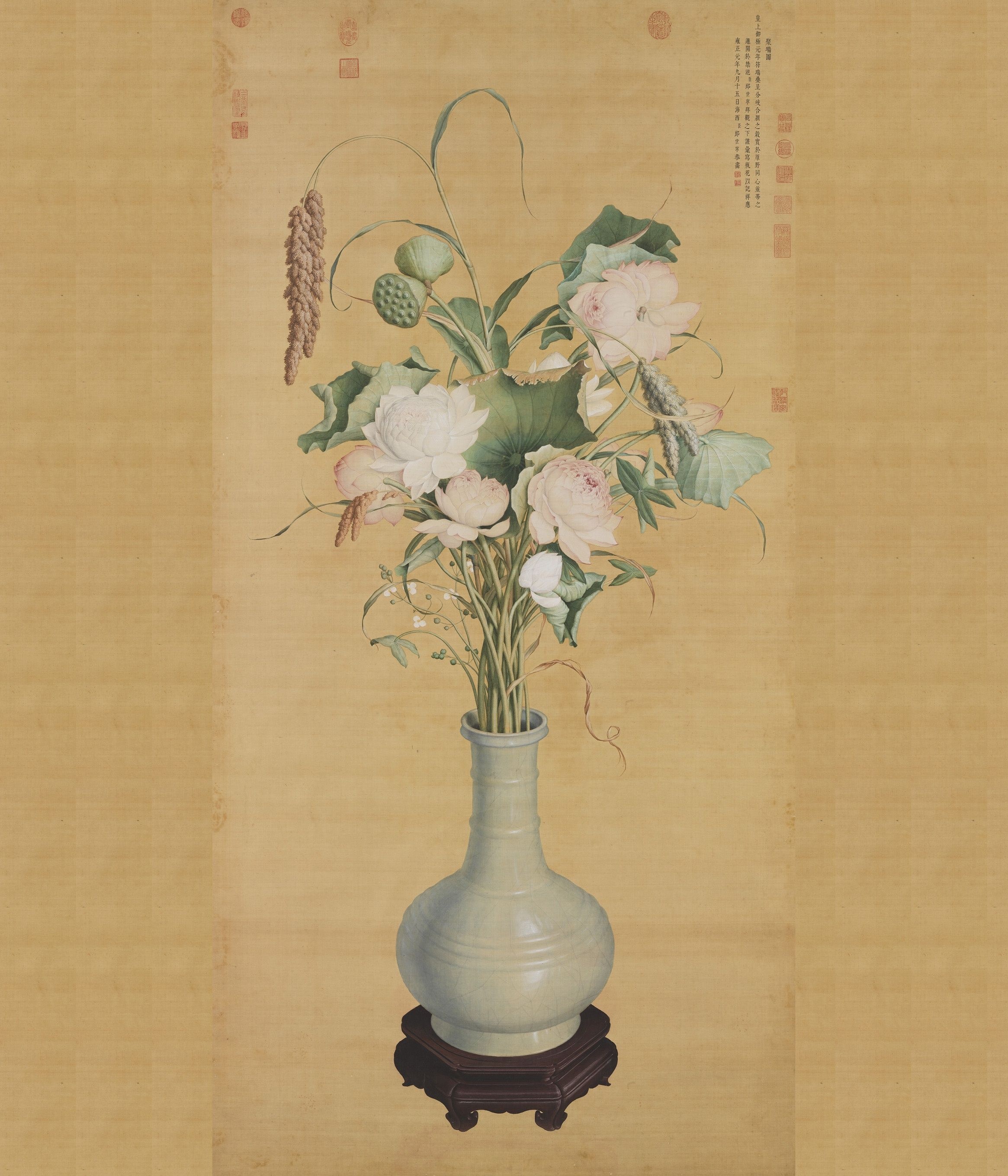
Court archival records state that on the eighth day of the fourth month of Yongzheng tenth year (1732), the Yongzheng emperor (r. 1723~1735) ordered Tang Dai (唐岱, 1673~1754) and Castiglione to make one painting each to be used for the Double Fifth. Following Jan Stuart and Wei Dong, I believe it is likely that the Castiglione version in Beijing is this painting. It was mainly during the Yongzheng reign that Castiglione made compositions with a single vase in the center such as this, applying Western techniques coherently, including shadows. Castiglione’s Gathered Auspiciousness (聚瑞圖) dated to the inaugural year of the Yongzheng reign (1723) is a representative example (Fig. 3). Both the single vase composition and the application of strong shadows fell out of favor by the Qianlong reign. In Castiglione’s Double Fifth, the shadows are highly noticeable in the rice cakes wrapped with bamboo leaves.
『清宮內務府造辦處檔案總匯』, 畫作, 雍정十年四月初八日. Curiously, a note placed at the end of this entry dated to the twenty-ninth day states that after the two artists finished the painting, the Yongzheng emperor ordered Zhang Dai’s work to be brought out. Also, a separate report made on the twenty-ninth day regarding painted enamelware for the Double Fifth states that painters Dai Heng (戴恆, act. 18c.) and Tang Zhenji (湯振基, act. 18c) are to execute the enamel painting, with Tang Dai’s painting as a reference. These records imply that among the two submitted works, Yongzheng favored Tang Dai’s over Castiglione’s. See 『清宮內務府造辦處檔案總匯』, 記事雜錄, 雍正十年四월二十九日.
Stuart, “Timely Images,” p. 338; 畏冬, 「郎世寧與清宮節令畫」, 『故宮博物院院刊』 no. 2 (1988), p. 81.
The anonymous Double Fifth in Taipei was once misattributed to the Yuan dynasty, but in 1997, Liu Fang-ju dated the painting to the Ming or later on iconographic grounds: the figure depicted on the top middle part of the painting is Zhong Kui the demon-quelling ghost. Zhong Kui was originally pasted on walls on New Year’s Eve to exorcise evil ghosts and demons. According to Liu, using Zhong Kui for the Double Fifth began in the mid-Ming period, so the occurrence of Zhong Kui in the painting for the Double Fifth means that it was made after the Yuan.
劉芳如, 『迎歲集福 — 院藏鍾馗名畫特展』 (臺北: 國立故宮博物院, 1997), pp. 139–142. There is another painting in the Freer Gallery which very closely resembles the Taipei version. The Freer painting also has Zhong Kui at the top, painted in red ink, and Daoist talismanic characters. But there is a fake calligraphy of the Song emperor Huizong on this painting, which makes it a forgery.
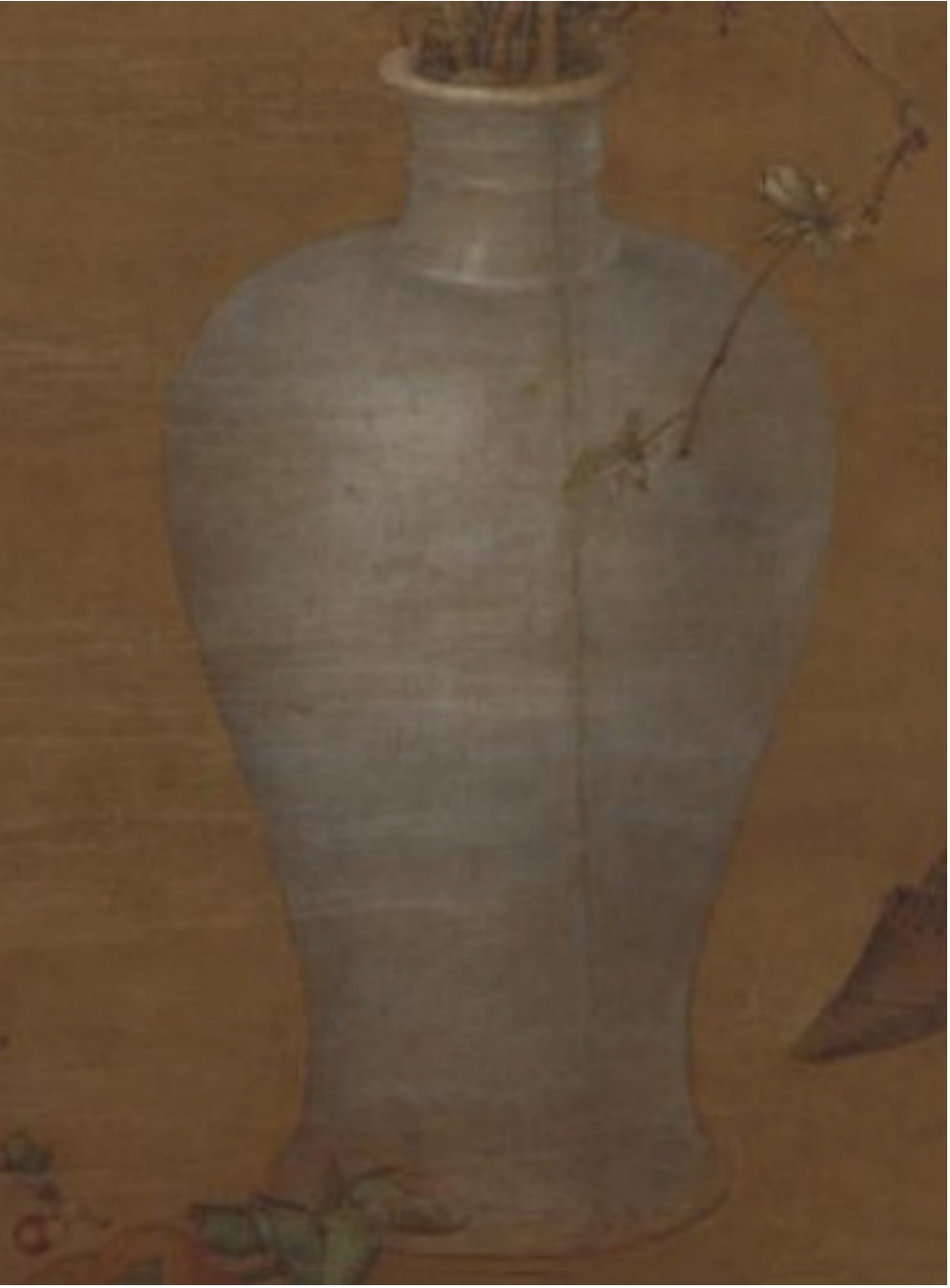
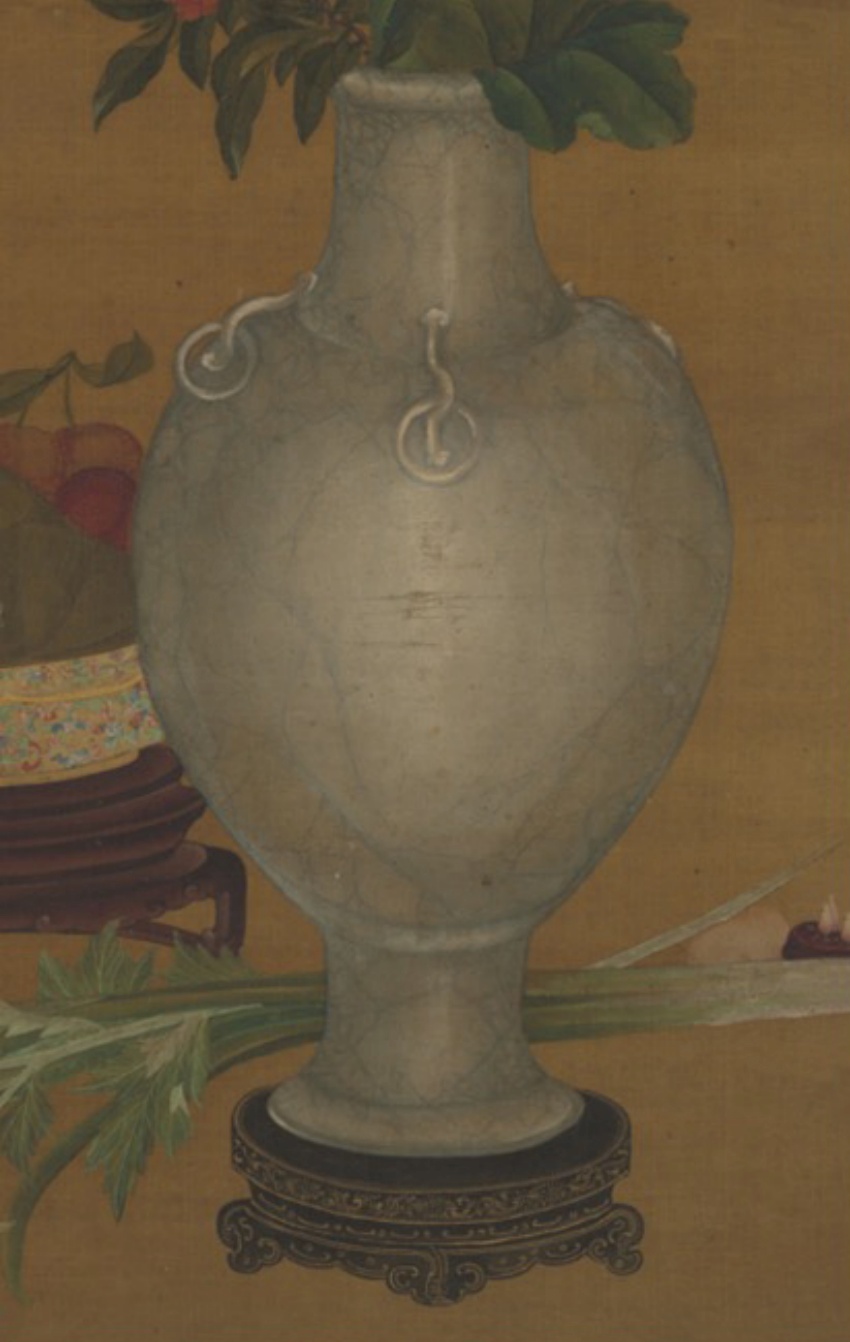
In my opinion, the modeling of the vase in the Taipei version with white pigment dates the painting not only to a post-Yuan date, but more specifically to the eighteenth century when Chinese court painters learned such techniques from European painters working at the Qing court. How much the Taipei version is indebted especially to Castiglione is evident at the neck of the vase in the Taipei version. In the Castiglione version in Beijing, the sheen of the vase on the neck is represented by a short fuzzy application of white pigment (Fig. 4). In the Taipei version, there is a much longer and harsher white stroke at the center of the neck, which should represent the sheen but appears almost like a mark (Fig. 5). So, the Taipei version indeed shows an effort to replicate Castiglione’s style, and at least in this regard, it is less skillful.
Two aspects of the Taipei version, I propose, date the painting even more specifically to the Qianlong period (1735~1796). If my hypothesis is correct, then the Taipei version was made at least three years later than the Castiglione version which was likely painted in 1732. Firstly, the top part of the painting shows five lappet-like squares inside which are painted talismanic characters and Zhong Kui. I will discuss the characters and Zhong Kui in the next section. Here, I will point out that numerous auspicious images made as hanging panels in the Qianlong reign have this lappet-like structure at the top. An enamel panel dated by the Palace Museum researchers to the Qianlong period that is currently hanging in the Hall of Supreme Ultimate (太極殿) serves as a case in point (Fig. 6).
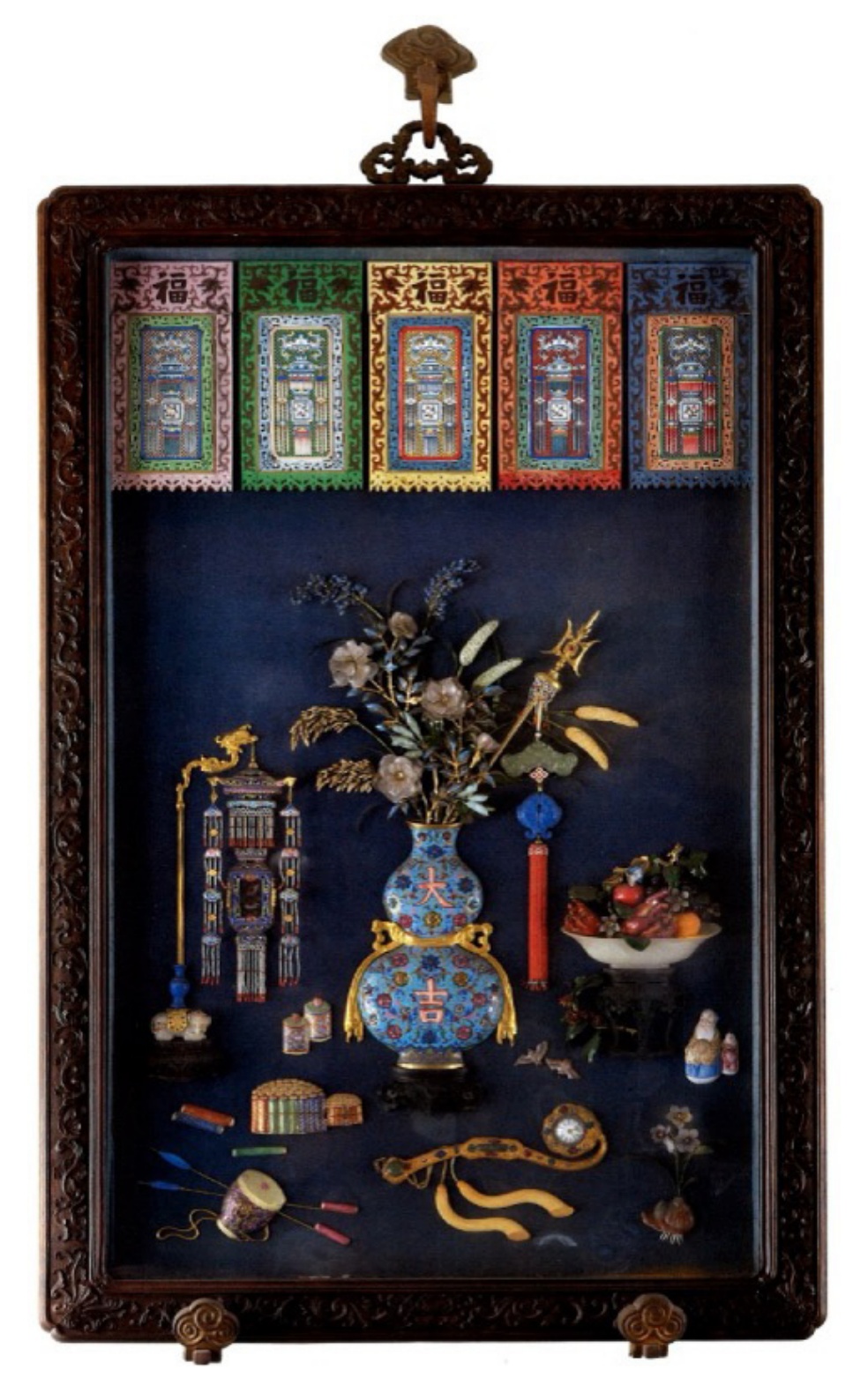
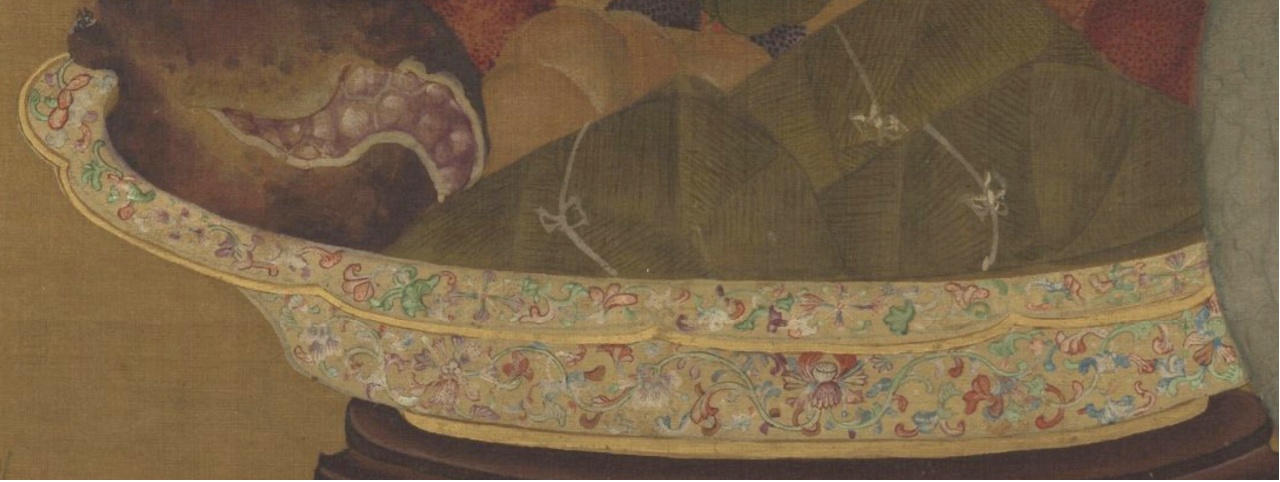
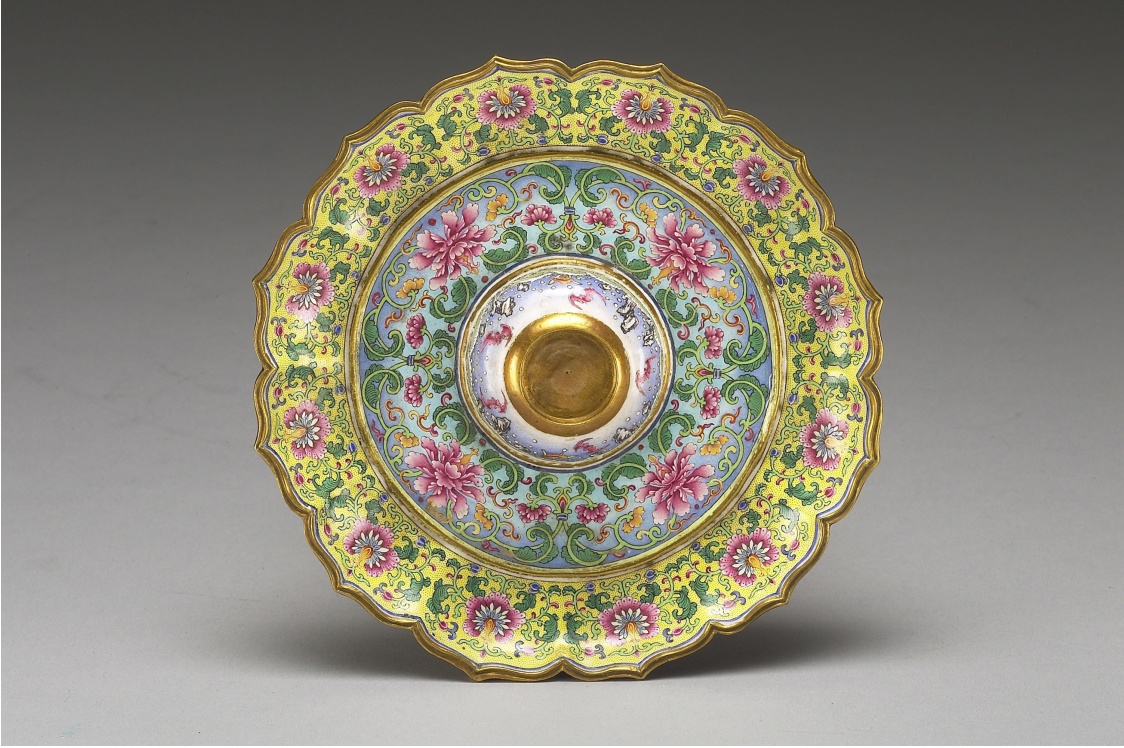
The panel’s status as an auspicious image is evident in the two characters on the central gourd-shaped vase, “great auspiciousness” (大吉). The panel shows the lappet structure at the top. Each lappet shows a happiness character and a lantern. That the Taipei Double Fifth painting shows this similar lappet structure suggests that it was made in the Qianlong reign. Secondly, the enamel dish in the Taipei version is a type of painted enamel that became popular during the Qianlong reign. With jewel-toned green, reddish purple, and purple-ish blue,the dish shows varied and more saturated enamel colors of the Qianlong reign (Fig. 7). Also, the exotic lotus scroll design with strong shadow effects resemble the style of shallow enamelled bronze dishes made in the Qianlong period (Fig. 8). Based on the stylistic features of the lappet squares and the enamel dish, I submit that the Taipei Double Fifth can be dated to the Qianlong period. All seals on the painting are Qianlong seals except for one by Puyi (and the ones inside the lappet squares to be discussed later), so they do not contradict the dating of the painting to the Qianlong reign.
Court archival records frequently state that Qianlong ordered court painters to make paintings to be used for the Double Fifth. Sometimes, he did not designate painters, ordering only how many paintings in what sizes should be made. Other times, he specified which painters should work on the project. For example, in the fourth month of the fourth year of Qianlong reign (1739), the emperor ordered Dai Zheng (戴正, act. 18c), Zhang Weibang (長為邦, act. 18c), and Wang Youxue (王幼學, act. 18c) to each make a painting for the upcoming Double Fifth and submit them to him. Zhang Weibang was one of the two painters who painted illustrations for the Album of Beasts (獸譜) completed in 1761, which included leaves painted in Western style. Wang Youxue was a student of Castiglione. It is possible that one of these painters made the Taipei Double Fifth, judging from the Western techniques applied to the vase. And it is possible for either of them to have directly referred to the Castiglione version when they made the painting, given the close similarity in composition and content between the two versions. It was a common practice for court painters to refer to existing works to make new paintings, or to turn existing paintings into works in other mediums. Such practices were not done out of the painters’ whim but often ordered by Qianlong himself.
『清宮內務府造辦處檔案總匯』, 記事錄, 乾隆七년四월十三일.
『清宮內務府造辦處檔案總匯』, 畫院處, 乾隆四年四월十七일.
Considering the stylistic issues and historical records discussed above, it seems reasonable to speculate that the Taipei Double Fifth was made during the Qianlong reign. Even if it was not made by Zhang Weibang or Wang Youxue, it was certainly made by a court painter of a similar status who knew how to approximate Western techniques. Also, the level of similarity between the two paintings makes it reasonable to think that one painting directly referred to the other. Until now, it has only been presumed that the Castiglione version was made after and improved upon the Taipei version in terms of its realistic style. I raised a new possibility that the Taipei version was made after the Castiglione version with a more comprehensive iconography. But beyond iconography, the next section will argue, the Taipei version also seeks to be efficacious stylistically and pictorially in a way other than through mimesis.
Ⅲ. How the Painting Asserts Its Efficacy
The Taipei Double Fifth shares with Castiglione’s Double Fifth the basic structure of a vase with summer flowers and a dish filled with fruits and cakes eaten on the Double Fifth. Beyond these commonalities, however, there are three significant additions to the Taipei version: the four lappet squares (條幅) with characters written on them, the central lappet square showing Zhong Kui, and lastly, a paper talisman (紙符) in the shape of a tiger hanging down from a pomegranate sprig by a red thread (朱索). All three additions are key to understanding how the painting asserts its own efficacy.
1. The Daoist Talismans
Flanking Zhong Kui on both sides, there are four lappet squares showing two characters each written vertically. All existing descriptions of the painting mention only briefly that these characters are reminiscent of ‘Daoist talismans.’10 However, the connection between the Double Fifth and Daoist talismans run much deeper. Lü Xizhe’s (吕希哲, 1039~1116) Miscellaneous Records of Seasonal Festivals (歲時雜記), which is included in Chen Yuanjing’s (陳元靚, ?~?) Expanded Record of Seasonal Festivals (歲時廣記), writes that “on the Double Fifth, people of the capital paint images of the Celestial Master for sale.”11 The term ‘Celestial Master’ makes a clear reference to the Orthodox Unity (正一) sect of Daoism, which is also known as the Way of the Celestial Master (天師道). The Orthodox Unity sect was founded in 142 in Sichuan by Zhang Daoling (張道陵, ?~c. 156), the first Celestial Master, who promised to save people from worldly turmoils and lead them into a new age of Great Peace.12 According to the Orthodox Unity beliefs, Lord Lao, the divine personification of the Way, endowed Zhang with healing powers. The legacy of Zhang Daoling was continued by successive Celestial Masters as the Orthodox Unity grew into one of the three major sects of Daoism.13
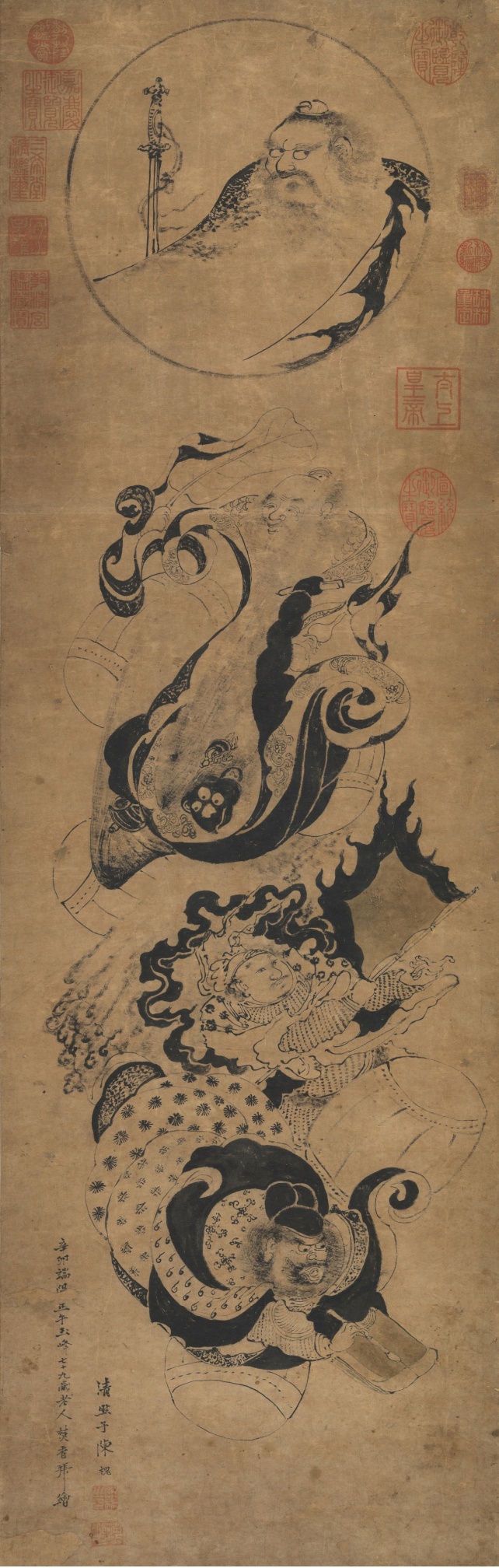
A painting kept at the National Palace Museum in Taipei by a Ming dynasty painter Chen Huai (陳槐, ?~?) vividly illustrates how images of the Celestial Master were used on the Double Fifth (Fig. 9). On the lower left corner of the painting, there is an artist inscription: “On the noon of the Double Fifth of the xinmao year, seventy-nine-year-old old man Yufeng burned incense and painted in reverence.”14 The figure depicted inside the top aureole with a sword is Zhang Daoling, the first Celestial Master. Below, there are four figures, each holding a leaf fan, wielding a mallet, brandishing a banner, and keeping records. Based on appearances, they seem to be the four popular marshals from the Thunder Division (雷部) of the Orthodox Unity: at the top is Ma Lingguan (馬靈管), who controls wind; below is Deng Bowen (鄧伯溫), the commander of the thunder troop, often depicted with a mallet; the third figure, although less clearly identifiable than others, may be Wen Qiong (溫瓊), the general of thunder fire; and at the bottom seems to be Zhao Gongming (趙公明) who, besides thunder, also governs wealth and heavenly retribution, hence the record-keeping.15 The five drums interspersed throughout the painting may stand for the Five Thunders (五雷): heaven thunder, dragon thunder, water thunder, divine thunder, and the altar of earth or demonic thunder (天雷, 龍雷, 水雷, 神雷, 社令雷/妖雷).16 Together, the figures and the drums reflect the connection between the Double Fifth and the Daoist Thunder Rites (雷法), which first arose during the reign of Emperor Huizong (r. 1100~1126) who greatly sponsored Daoism. The Thunder Rites exort to the pantheon of deities in the Thunder Division to bring rain, expel demons, and heal diseases.17 Naturally, people began to lean into the Thunder deities to seek protection or pray for rain on the Double Fifth.
By the Ming dynasty, the practice of hanging Celestial Master portraits gradually shifted to hanging Five Thunder Talismans (五雷符). The Survey of the Scenery of the Imperial Capital (帝京景물略) by Liu Tong (1997) observes that on the Double Fifth, “Every household hangs up Five Thunder Talismans; people also wear or pin on small paper talismans, sometimes in the shapes of the Five Poisons or of five auspicious flowers and plants.”18 Five Thunder Talismans are a group of five marshals selected from the Thunder Division depicted in talismanic forms (the composition of the group may vary). Indeed, the talismanic characters on the top of the Taipei Double Fifth can be identified as the Five Thunder Talismans. The first character in all four squares is the same: it is called the eight trigrams talisman header (八卦符頭). Each character underneath the header, from left to right, may be read as follows: Marshal Yin, the Commandar of the Grand Year (太歲統領殷元帥); Marshal Zhao, the General of the Dark Altar (玄壇趙元帅); Marshal Ma, the Spirit Officer (靈管馬元帅); and Marshal Wen, the Aiding Spirit and Marshal Defender (翊靈昭武溫元帥).19 This grouping overlaps with the figures depicted in Chen Huai’s painting except for two differences: the Celestial Master Zhang Daoling was replaced by Zhong Kui, and Marshal Deng was replaced by Marshal Yin, who is considered the leader of the Thunder marshals.20 Furthermore, the same seal is repeated in all of the lappet squares except for the one showing Zhong Kui. The seal reads “Expedient Seal of Thunder (雷霆便宜之印),” confirming the nature of the talismans as connected to the Thunder Division.
A court archival record further clenches the connection between the Taipei Double Fifth and the Thunder Rites of the Orthodox Unity sect. An imperial order dated to the ninth day, fifth month, fifth year of the Qianlong reign (1740) states: “if any work prepared for the Double Fifth requires talismans to be painted on it, Lou Jinyuan is to be assigned to paint the talismans.”21 Lou Jinyuan (娄近垣, written in the archive as 娄金垣, 1689~1776) was a Daoist priest of the Orthodox Unity sect who came to Beijing in 1727. He gained the Yongzheng emperor’s trust in 1730 by treating the emperor’s illness, and even after Yongzheng passed away, Lou continued to reside in the capital and served at the court of the Qianlong emperor.22 Since Lou trained in Mt. Longhu, the mecca of the Orthodox Unity sect where the Thunder Rites were passed down, it is highly likely that Lou wrote the Five Thunder Talismans on the Taipei Double Fifth.23 This record also supports my theory, suggested earlier, that the Taipei Double Fifth was made in the Qianlong reign and post-dates the Castiglione version.
Qianlong’s imperial order shows that the emperor did not entrust the job of writing talismans on Double Fifth paintings to just anybody. In Daoist practices, talismans work not just because of the appearance of the final product. Rather, greater emphasis is put on the agent, timing, and process: it matters who writes the talismans, when he writes them, and how he writes and activates them. Therefore, every Daoist treatise on writing talismans, registers, and diagrams stipulates bodily ritual practices such as fasting, taking a bath, chanting incantations, ordering the breath, and controlling the vision.24 That is to say, the mechanism of talismans runs counter to the power of mimetic resemblance. Even if one were to exactly replicate these talismans, the replica would not work, because they did not go through the same ritual process that gave the talismans their power in the first place.25
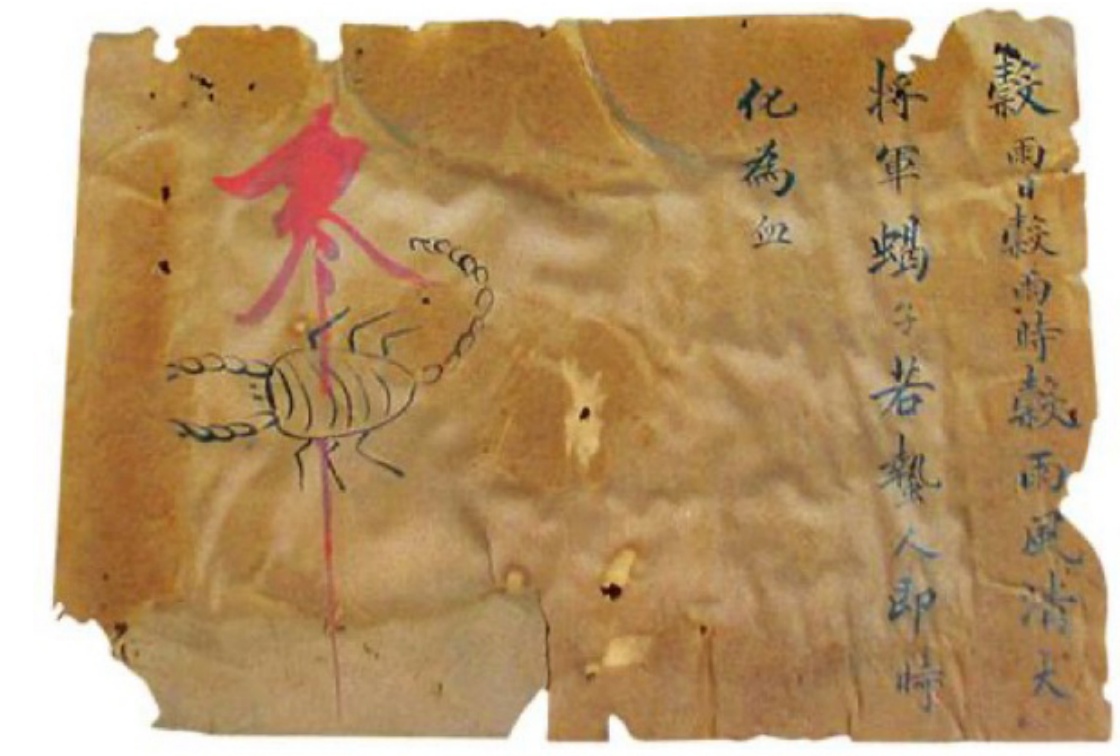
A look into a specimen of Five Poisons Talisman, which is mentioned in the Survey of the Scenery of the Imperial Capital quoted above, demonstrates the workings of talismans used for the Double Fifth. The Five Poisons (五毒) refer to five poisonous creatures, which usually consist of centipedes, scorpions, snakes, lizards, and toads. These are harmful creatures that become active from the Grain Rain (穀雨), one of the twenty-four solar terms that falls between late April and early May. A Five Poisons Talisman found inside the Forbidden City illustrates how Double Fifth talismans work not in virtue of mimetic resemblance, but by directly summoning divine power and channeling the power into the talisman body (Fig. 10).26 The talisman was found in the Palace of Constructing Happiness (建福宮), attached to the backside of a zitan wood chest which likely belonged to a palace woman. On the right side, there is an incantation calling upon the General of Grain Rain (穀雨大將軍) to strike a scorpion if it tries to sting humans. The left side, on the other hand, is neither a linguistic symbol nor a realistic representation. The only way to describe it is that the word ‘edict’ (敕令) is poking through a scorpion. Thus, the image part of the talisman functions precisely as trigrams do, imaging a process that is comprehensible and operational, yet is neither purely a linguistic symbol nor a sheer mimicry of appearances.27
2. Zhong Kui
In the Taipei Double Fifth, the conventional Five Thunder Talismans are changed to represent Zhong Kui instead of the Celestial Master. As mentioned earlier, scholars posit that Zhong Kui began to be associated with the Double Fifth some time during the Ming. The explicit mention of Zhong Kui as an image to use on the Double Fifth is found in the Annual Customs and Festivals in Peking (postscript dated to 1900, hereafter Annual Customs):
“Every year at the time of the Double Fifth, shops have yellow streamers a foot long, covered with vermilion seal impressions, or perhaps painted with figures of the Celestial Master or of Zhong Kui, or with the forms of the five poisonous creatures, which serve as charms. These are hung up and sold, and the people of the Capital compete with one another in buying them. They are pasted on the second gate of one’s house to ward off evil influences.”28
As such, by the late Qing dynasty in the capital, images of Zhong Kui were used alongside or in place of images of the Celestial Master. Since the portrait of the Celestial Master would have given an image too strong a Daoist flavor, people may have started to use Zhong Kui as an image that is easier to recognize, has a broader appeal, and wields the same exorcistic power.
The addition of Zhong Kui to the Taipei Double Fifth imbues the painting with yet another layer of efficaciousness that is distinct from the four talismans.29 Since Zhong Kui was incorporated into the Daoist pantheon as early as the Song dynasty, it is a common practice to consider a Zhong Kui image in the same spirit as images of other Daoist or popular gods.30 However, I argue that there is a fundamental difference between icons of gods, Daoist or otherwise, and an image of Zhong Kui. Icons are religious images of higher beings made as focal points for worshipping those higher beings. But Zhong Kui is not a figure who is worshipped, he is not even ‘believed in’ in the conventional sense of believing in gods or spirits. According to Chun-Yi Joyce Tsai, Zhong Kui originally meant a mallet with exorcising powers.31 The demon-queller attained his present form only in the Tang dynasty through the story of Tang Xuanzong’s seeing Zhong Kui in his dream and being healed of malaria.32 Upon waking, Xuanzong summoned Wu Daozi to paint his dream vision of Zhong Kui and distributed copies of the painting to his officials.33 One could argue that the essence of the story is less about the particular figure of Zhong Kui, but more about how images become powerful. The story’s overarching concern with this question is apparent: for one, it makes up an elaborate background history of Zhong Kui as a civil exam candidate to justify his being depicted in a green-rank civil official’s uniform. In this way, the story sets a detailed iconographic prototype that all subsequent painters who want to create an apotropaic image can follow. Also, the story’s featuring of Wu Daozi is certainly meant to emphasize that Zhong Kui’s exorcistic and healing power lies in a visual experience—the efficacy comes not from contacting with or praying to Zhong Kui, but from seeing Zhong Kui. This makes Zhong Kui a personified visualization of the very concept of the power of images. All subsequent images of Zhong Kui, including the Taipei Double Fifth, function in the same way as Xuanzong’s efficacious dream vision.
3. Paper Tiger
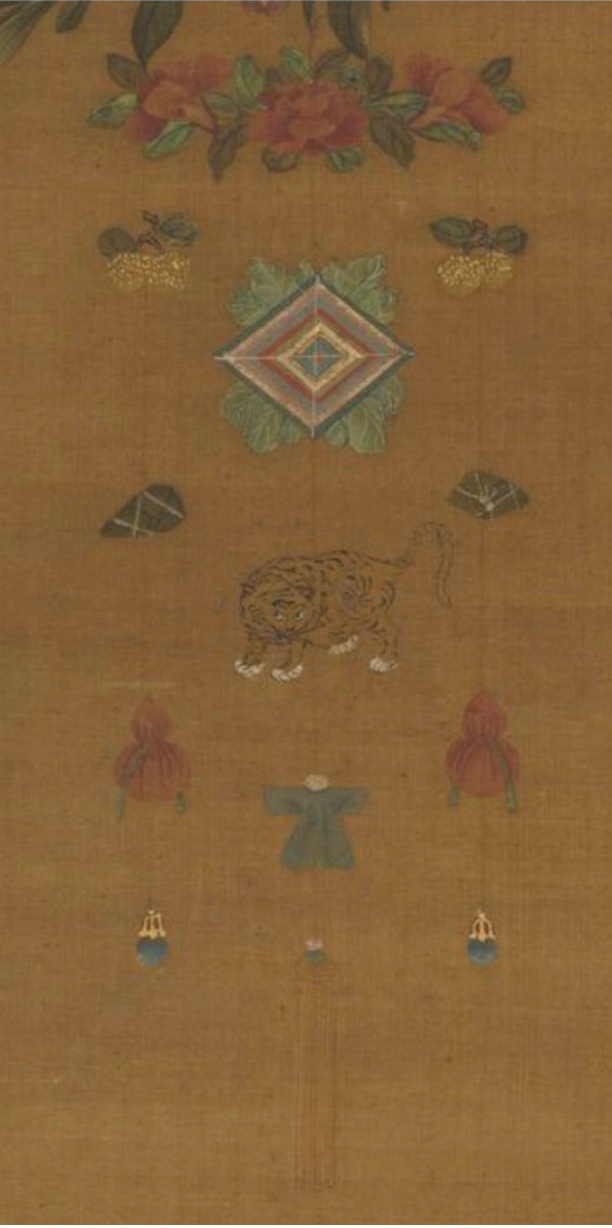
The final device in the Taipei Double Fifth asserting the painting’s own efficacy can be found in the objects hanging down from a pomegranate branch. Three red cords hang down from the sprig, and on them are tied various miniature objects: a square made of multiple colors of silk, cherries, glutinous rice cakes, fragrant pouches in gourd and robe shapes, earrings, and decorative silk knots. In the middle, there is a tiger cut out of paper. The Annual Customs helps us understand lucidly what these miniature objects are:
“Every year on the Double Fifth the clever ones in the women’s quarters cut out of silk gauze such things as small tigers, glutinous rice cakes, gourds, cherries, and mulberries, and string them together on a colored silk thread. These they suspend from the heads of their hairpins, or tie on the backs of small children. An old poem speaking of “A jade swallow on the head of a hairpin; a trifling mugwort tiger,” refers to this.”34
The objects mentioned in the quote largely overlap with the objects hanging on the red thread in the painting. According to the Annual Customs, these objects as well as the colored threads tying them up prevent people from catching infectious diseases.
Objects that are worn by women or children on the Double Fifth in real life are represented in the painting like a mobile. However, the purpose of this detail is not to represent this custom like an illustration in an ethnographic survey. Women and children who are supposed to wear them are not represented, so there is no way for someone who is not familiar with the custom to tell how these objects are used. Even if the objects were represented as worn by people, an outsider still would not get what the objects are for and would probably think that they were mere decorations. The painting takes another direction: it presents the objects just as people in real life would have seen and used them, that is, as apotropaic charms suspended on red threads. In other words, these objects do not merely represent the custom of the Double Fifth for its viewers to iconographically study them; rather, the hanging objects are the custom, in which the viewers are supposed to participate.
The painting’s invitation to participate in its spectacle, I believe, is insinuated by the paper tiger in the middle of the mobile. The tiger, although it is supposed to be a paper tiger, appears animated due to its posture and lively stare (Fig. 11). The immediate sense which this liveliness conjures is that of incongruity. Rationally, the paper tiger cannot be a living object. The tiger’s miniature scale and its placement among other table-top objects obviously defy any plausibility of depicting a real tiger realistically or naturalistically. Rather, what is brought up by the artist’s hand is a new category of object which I will call a ‘living paper tiger.’ The living paper tiger is not an illusionistic tiger. It is an animated miniature. What is the function of this excess of animation? A linguistic symbol signifies what it means regardless of how it is drawn, so it does not require such liveliness. On the other hand, if the tiger was meant as a mimetic representation, then the lively stare and posture alone are insufficient to portray a realistic tiger. Even though there is a sense of animation, the painting does not portray the paper tiger like a real tiger, with correct scale, accurate muscle movement, detailed coat texture, and so on. I would argue that the liveliness of the paper tiger makes the viewers who understand the custom of hanging paper tigers see the active agency embedded in the image: one is supposed to see the painting as lively and active.
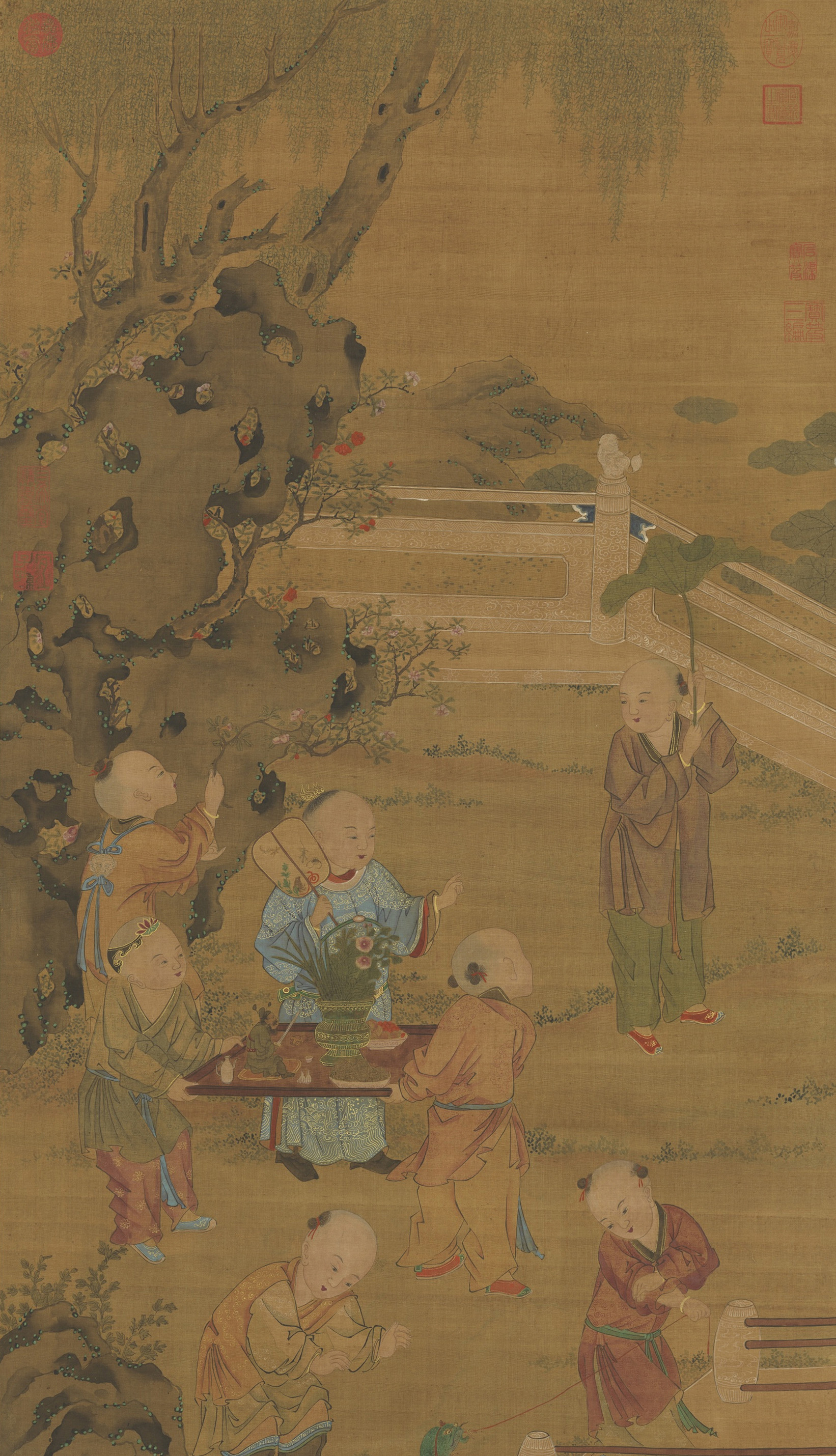
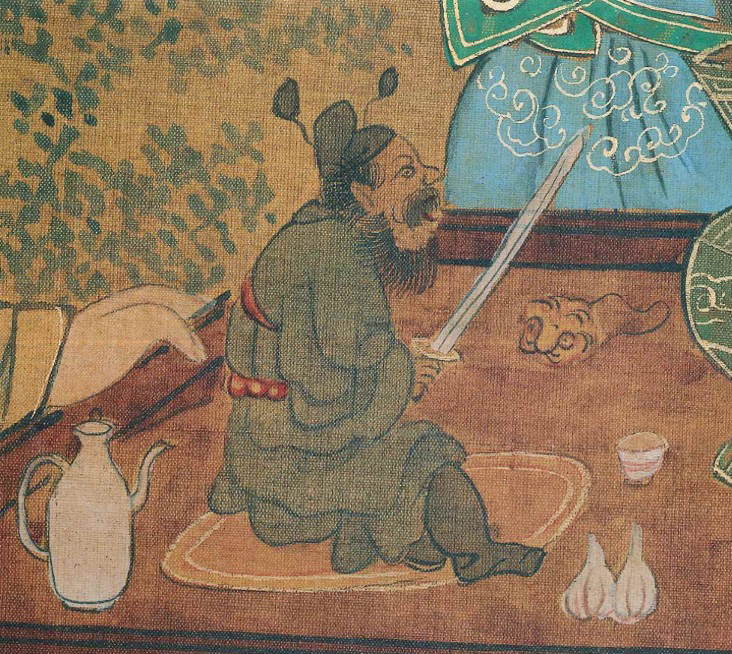
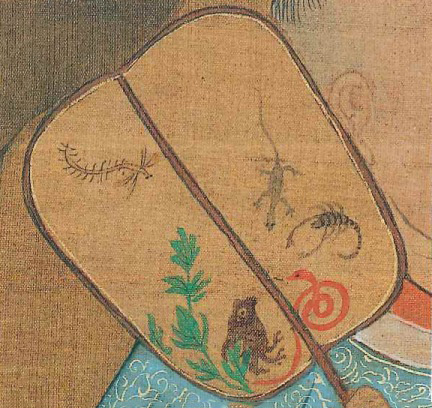
Such excess of animation in an inanimate object is often observed in auspicious images. Children Playing with Marionettes at the National Palace Museum in Taipei is a prime case in point (Fig. 12). In the painting, children are absorbed in a marionette play. The moving marionette they are watching is Zhong Kui, identifiable by the official’s robe and cap and black boots (Fig. 13). His status as an animated miniature is clearly indicated by the eye contact he is making with one of the children. On the lower right corner, there is a hoard of other dolls anxiously waiting for their turn in the same lively spirit, each looking at different directions (Fig. 14). In another painting of children playing, a miniature Zhong Kui is sitting on a little table that children are holding (Fig. 15). Upon close look, the miniature Zhong Kui is alive, holding a sword and about to strike a worm-like demon (Fig. 16). One of the children is holding a fan with images of the five poisonous creatures, confirming that this painting is made for the Double Fifth (Fig. 17).35
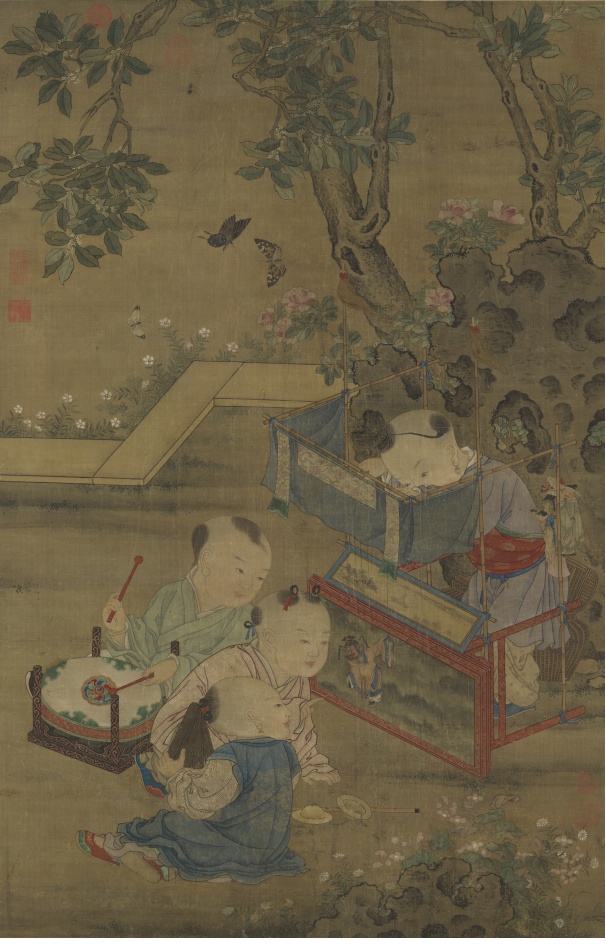
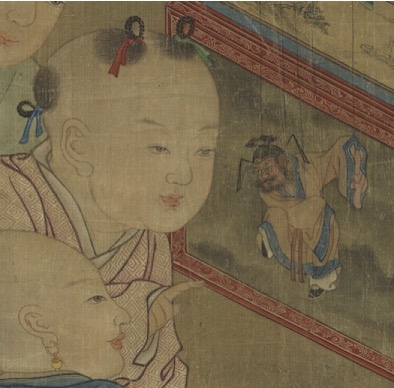
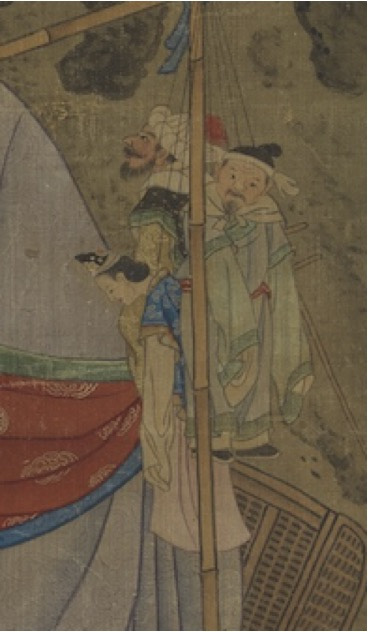
Such animated miniatures as a category of objects demonstrate how images can claim efficacy and invite participation without necessarily resorting to realistic representation. Without lifesize scale, mass, and volume, which are conventionally understood as elements of realism, the paper tiger and marionette Zhong Kui still manage to appear lifelike. These examples adequately show us that a painting needs not meet a certain threshold of realism in order to gain the alchemy of animation. Looking at a painting is an imaginative act. One could make a blob of paint animated if one wanted to. One can create a new entity such as a living paper tiger, a mischievous marionette, a smiling Daoist immortal. Too little is gained by giving up the imagination and passively letting the pictorial style of virtual reality take hold of our senses, which is why a merely realistic painting quickly loses our interest. Animation of a painted figure does not always rely on, in fact it seldom does, on pictorial realism or naturalism alone. Rather, the liveliness of a miniature is one potent way in which a painting can indicate its own efficacious agency.
Ⅳ. Conclusion: A Different Power of Images
Based on stylistic clues and historical records, I believe the Taipei Double Fifth was likely made by one of the court painters in the early Qianlong reign following closely upon the Castiglione version. Establishing the order between the two versions, as I have attempted in this paper, helps free our mind from the tendency to assign an earlier and provisionary status to a less Westernized version when it comes to Qing court paintings. Reversing that order helps us see the anonymous version not as a preparatory sketch for a more polished Western version, but as a work of art that pursues efficacy in its own right. By adding the Daoist talismans, Zhong Kui, and the paper tiger, the Taipei version more faithfully replicates the custom of the Double Fifth mentioned in various historical records.
At the same time, it is not just in this iconographic sense that the Taipei version asserts its efficacy. Castiglione makes the painting coherent, so much so that the painting is truly indistinguishable from a painting depicting everyday life. The poignancy of mimesis thus achieved may be one way through which images gain efficacy. However, it may not be the only way. Other possibilities can be found in the Taipei version, in the agency of the talismans, the legend of Zhong Kui as a healing vision, the animation of the paper tiger—the power of images to which all who belong in the same culture subscribe. The addition of all these elements may take away from mimetic perfection, resulting in a subtle sense of incongruity within harmony. The sense of incongruity is found in the space of the painting suddenly collapsing into the flatness of the lappet squares. It is found in the excess of animation that creates the incoherent category of a living paper tiger. But these incongruities do not have to be labeled as mistakes or imperfections. Rather, they can be explained, with reason and evidence, as a painting’s own indication that it does more than merely representing a mundane still life. They may be the painting’s invitation for us, if we are so inclined, to behold the power of images and participate in its efficacious spectacle.